

image

Polycarbonate Panel Greenhouse 10

Commercial PC greenhouse

Commercial pc greenhouses allow for the intake of sunlight while preventing scorching.
Key Features:
Quantity
Minimum order quantity :  0
My Inquiry
add to the cart
Share
In commercial cultivation, light is often a double-edged sword. When procuring commercial greenhouses, many growers prioritize high light transmission, opting for standard float glass or clear plastic films. However, during periods of intense summer sunlight, this can lead to localized overheating at the top of the greenhouse, triggering widespread crop disease. Furthermore, the lower foliage—trapped in deep, persistent shadow—suffers from poor photosynthetic efficiency, ultimately reducing yields. Commercial PC greenhouses have become the industry standard for high-end berry, solanaceous crop, and premium cut-flower operations across North America, Europe, Australia, and the Middle East. This is due to their unique multi-layered, hollow optical structure, which transforms harsh, potentially damaging direct sunlight into soft, omnidirectional diffused light—eliminating the risk of scorching at the top while stimulating growth in the lower canopy.
 

Why is direct light an invisible killer in commercial cultivation? 

 
In traditional commercial greenhouses, sunlight enters through the roof as parallel, direct beams. Passing through a single layer of transparent material, these rays create highly concentrated infrared thermal radiation on the tops of the plants. For high-value crops such as tomatoes, bell peppers, and strawberries, the surface temperature of immature fruit can rapidly surge to over 40°C–45°C under intense direct sunlight, leading to discoloration, dehydration, and skin cracking. Furthermore, when light intensity exceeds the crop's light saturation point, photosynthesis stalls, directly hindering plant growth. Additionally, these parallel, direct light beams cast shadows, leaving the middle and lower portions of the plant in deep shade; unable to photosynthesize, the plant’s overall growth efficiency is significantly reduced.
 

How do commercial PC greenhouses address the pain points faced by growers? 


Commercial-grade polycarbonate (PC) sheets consist of parallel top and bottom layers connected by vertical or diagonal internal stiffening ribs. With a refractive index (n) of approximately 1.58, the polycarbonate material causes incoming direct sunlight to undergo numerous micro-interface refractions, internal total reflections, and secondary scattering events. This transforms sharp, unidirectional light into diffuse light that radiates in all directions across a 360-degree hemispherical space. Photosynthetically active radiation (PAR) is maintained at 78%–82%, effectively eliminating harsh, distinct shadows. This diffuse light penetrates the dense upper canopy to reach the middle and lower sections of the plants, stimulating photosynthesis in the lower leaves. Through a co-extrusion process, a 50-micron-thick layer containing a high concentration of hindered-amine UV stabilizers is integrated into the surface of the PC sheet. This layer filters out damaging ultraviolet radiation—preventing it from directly scorching delicate plant shoots and flower buds—while also ensuring the structural integrity of the polycarbonate’s molecular chains, keeping the material free from yellowing or embrittlement for 10–15 years.
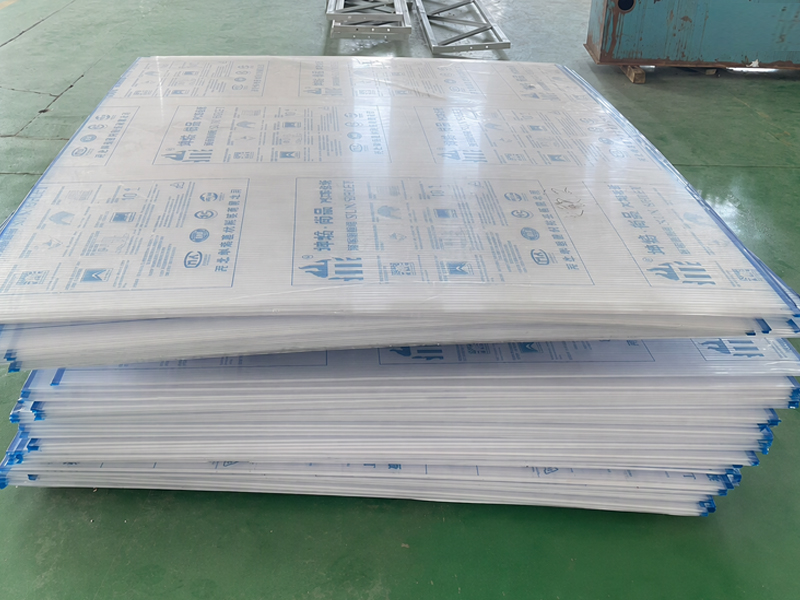
Polycarbonate sheets
 
Commercial farms are not academic research facilities; growers are primarily focused on return on investment (ROI). By addressing issues such as light scorch and insufficient light at the lower canopy levels, commercial PC greenhouses significantly boost farm profitability—a benefit manifested in several key areas. 
 
  • Increased proportion of high-quality produce: Prevents the occurrence of deformed, ulcerated, or albino fruits—particularly in high-quality tomatoes and bell peppers—and reduces the number of substandard fruits caused by sunburn.
  • Increased yield: The harvest period for the plants is significantly extended, the number of fruit-bearing nodes per plant increases, and the fresh fruit yield per unit area rises by 10%–20%. 
 
In the Middle East or tropical regions with high solar radiation—where summer temperatures can exceed 38°C–40°C—the optical diffusion provided by the greenhouse covering material alone is insufficient. An integrated, automated microclimate control system is essential. As a commercial greenhouses manufacturer, Zheyang equips its structures with highly reflective aluminum-foil external shading screens, motorized roof vents with a wide-opening continuous rack-and-pinion mechanism, and high-capacity negative-pressure exhaust fans paired with 150mm-thick evaporative cooling pads. This combination helps lower the internal temperature by 5°C–10°C, ensuring a safe physiological growth environment for the crops. 

Brand Trust

Brand Certification, Win-Win Cooperation

Construction Companies

We Provide Technical Design, Equipment Supply And Construction Coordination For Greenhouse Projects, Integrating Construction And Agricultural Technology Resources To Help Efficiently Complete Comprehensive Agricultural Projects.

Customized Precise Services

Our Technical Team Deeply Adapts To The Planting Needs Of Different Climate Zones And Crops, Providing You With a Full-Chain Customized Solution From Scheme Design To Operation And Maintenance Support.

Global Delivery Experience

Relying On Mature Experience Serving More Than 1,000 Customers In Over 90 Countries Worldwide, We Understand That Detailed Control Is The Core Guarantee Of Project Success, And We Can Efficiently Handle The Complex Scenarios And Delivery Requirements Of Overseas Projects.

Upload files
  • You can only upload 1 attachments at most
  • Supported formats: PDF,JPG,PNG,EXCEL,WORD,STP,IGS,DWG,DXF,PDF,STEP
  • The size of the uploaded file should not exceed 10MB