
image

Glass greenhouse 13

Diffuse Glass Commercial Greenhouse

What problems can diffuse glass commercial greenhouses help growers solve?
Key Features:
Quantity
Minimum order quantity :  0
My Inquiry
add to the cart
Share
Standard transparent glass is designed for human architecture, catering to human visual requirements. It acts much like a magnifying lens, transmitting intense, concentrated direct light that casts shadows across the cultivation area. In contrast, the diffuse glass commercial greenhouses designed by Zheyang are purpose-built for photosynthetic plants. From the chemical composition of the low-iron silicate glass to the refractive structures on its microscopic surface, these greenhouses enhance the ability of crops to receive uniform sunlight. So, what are the differences between diffuse-scattering glass and ordinary glass?
 
Standard horticultural glass contains iron impurities that absorb blue and red light; furthermore, a portion of the incoming light is reflected off the glass surface back into the sky, resulting in a loss of available light. Direct sunlight travels in parallel beams, meaning that in greenhouses with tall crops—reaching heights of 10–12 meters—the upper canopy receives up to 80% of the direct light, while the lower two-thirds remain in the shade. Large support columns, steel trusses, and automated shading screens cast dense shadows on sunny days, leading to uneven ripening of fruit in those shaded areas. On summer afternoons, direct solar radiation creates localized"hot spots"on leaf surfaces, where temperatures can be 3°C to 5°C higher than the ambient air. This causes the plant tissue to overheat, prompting the crops to close their stomata—a response that halts the transport of water and nutrients and brings photosynthesis to a complete stop. These challenges inherent to traditional glass greenhouses pose significant difficulties for growers; however, commercial greenhouses equipped with diffuse-scattering glass offer an effective solution to these problems. 
 

Advantages of using diffuse glass commercial greenhouses: 
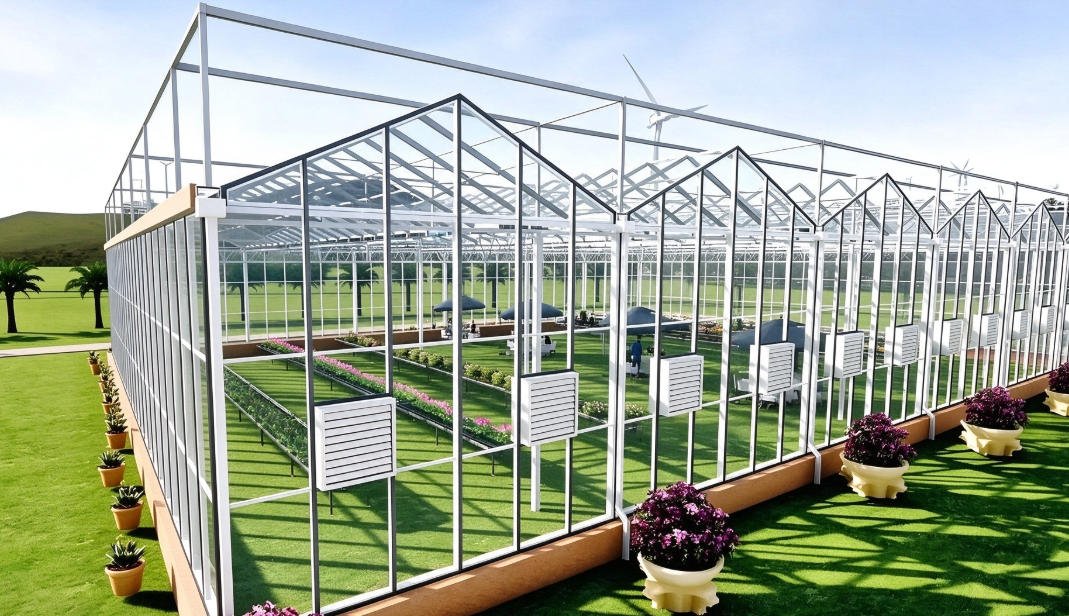
 
By utilizing low-iron float glass with an iron oxide content of less than 120 ppm, a hemispherical light transmission of 96.0% to over 97.5% is achieved. This provides an additional 6% to 8% of usable light daily. Incoming light is converted into multi-angle diffuse light, allowing photons to travel diagonally and horizontally between crop rows—reaching even the lower leaves. This ensures that the lower foliage remains biologically active, extends the duration of photosynthesis, and results in consistent appearance and sweetness across the fruit.
Diffuse Glass Commercial Greenhouse
Light can bypass steel trusses, drainage gutters, and suspended heating pipes, ensuring that no shadows fall upon the plants. Every plant receives uniform sunlight, which promotes consistent growth patterns and synchronized harvest times, while also simplifying management. Diffused light transforms concentrated solar thermal radiation into a dispersed thermal field, preventing energy from accumulating at the top of the greenhouse. This lowers the temperature at the canopy surface by 1°C to 3°C, allowing stomata to remain fully open and facilitating the continuous uptake of water, calcium, and carbon dioxide from morning until evening.
 

Case study: diffuse glass commercial greenhouses  

 
This French farm, which primarily grows tomatoes, initially utilized traditional glass greenhouses. Due to uneven light distribution, the fruit in the upper sections suffered from sunscald, while the fruit in the lower sections failed to develop properly, resulting in very low overall market prices. After switching to equipped with Zheyang diffuse glass commercial greenhouses, the shadows cast by structural components were eliminated, and leaf-surface humidity during peak light intensity was reduced. This enabled consistent and optimal photosynthesis across the entire plant canopy. As a result, the fruit is uniform and visually appealing—naturally commanding a higher price.
 

Before renovation:

  • Cultivation method: Utilizes a suspended, elevated-trough hydroponic system, equipped with an automated drip irrigation and fertigation system.
  • Environmental challenges: intense solar radiation during the summer, soaring midday temperatures, and occasional extreme weather events.

Commercial Greenhouse Solutions:

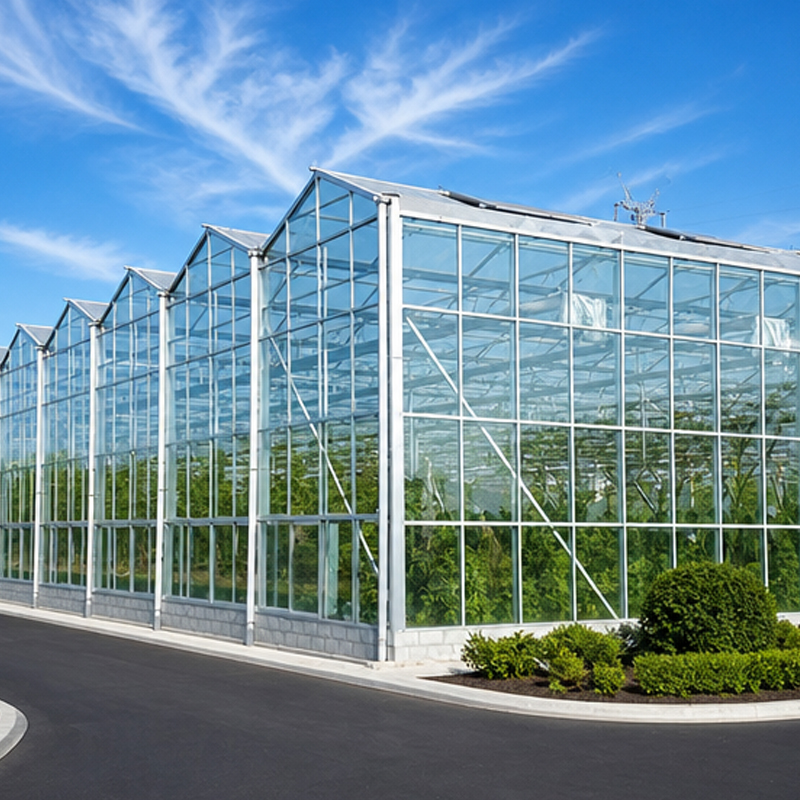
  • Optical cover material: 4 mm tempered diffuse-reflection glass, featuring a micro-prism textured surface and a dual-sided, nanoscale anti-reflective coating.
  • Greenhouse structure: Classic Venlo-style truss design, constructed from hot-dip galvanized steel; offers a long service life and high resistance to strong winds.
  • Automated Environmental Control: Continuous electric rack-and-pinion roof ventilation system, integrated with dual-layer shading and thermal insulation curtains.
Diffuse Glass Commercial Greenhouse​​​​
 
Are you currently facing challenges in your controlled-environment cultivation—such as crop scorching, high rates of fruit wastage, or uneven growth caused by shadows from greenhouse structural components? Contact the engineering department at Zheyang for a complimentary feasibility assessment of your project, and let us recommend the ideal solution for your needs. 

Brand Trust

Brand Certification, Win-Win Cooperation

Construction Companies

We Provide Technical Design, Equipment Supply And Construction Coordination For Greenhouse Projects, Integrating Construction And Agricultural Technology Resources To Help Efficiently Complete Comprehensive Agricultural Projects.

Customized Precise Services

Our Technical Team Deeply Adapts To The Planting Needs Of Different Climate Zones And Crops, Providing You With a Full-Chain Customized Solution From Scheme Design To Operation And Maintenance Support.

Global Delivery Experience

Relying On Mature Experience Serving More Than 1,000 Customers In Over 90 Countries Worldwide, We Understand That Detailed Control Is The Core Guarantee Of Project Success, And We Can Efficiently Handle The Complex Scenarios And Delivery Requirements Of Overseas Projects.

Upload files
  • You can only upload 1 attachments at most
  • Supported formats: PDF,JPG,PNG,EXCEL,WORD,STP,IGS,DWG,DXF,PDF,STEP
  • The size of the uploaded file should not exceed 10MB