







Multi-Span film greenhouse 10
Commercial film greenhouse
Zheyang customizes commercial film greenhouses for tomato cultivation.
Key Features:
Quantity
Minimum order quantity : 0
My Inquiry
add to the cart
Share
Should you choose a film greenhouse or a glass greenhouse for tomato cultivation? This is a primary question many commercial growers face when selecting a greenhouse. To determine the right covering material, you must first clarify your goals: if you aim for stable, high-quality tomato yields—with consistent fruit color and uniform size—what kind of structure should you choose? After a thorough analysis of the specific requirements for tomato cultivation, Zheyang recommends a commercial film greenhouse—a solution designed to help you increase both your tomato yields and your overall profitability.
Selection of Covering Materials by Film Greenhouse Suppliers
Zheyang offers professional anti-fog, anti-drip, and UV-resistant films, with the specific thickness selected based on the local climate:
- For regions with a mild climate and no strong winds, use a thickness of 0.12 mm.
- Conventional tomato cultivation sites use a thickness of 0.15 mm.
- For areas prone to hail in windy coastal regions, a thickness of 0.2 mm should be selected.
In addition, Zheyang offers diffuse-reflection films that ensure light is distributed more softly and evenly across the crop canopy. This prevents sunscald on the fruit while allowing the plants to carry out photosynthesis effectively, resulting in tomatoes with a uniform red color and superior visual quality.
Customize the framework structure according to the specific project
Designed with tomato cultivation in mind, these commercial film greenhouse feature a high-gutter configuration, with standard gutter heights ranging from 4.5 to 6.0 meters. Unlike low-arch greenhouses that restrict vertical plant growth, this ample vertical space provides sufficient room for trellising, vine training, pruning, and the proper suspension of fruit clusters. By ensuring that the upper fruit clusters do not come into contact with the roof, the design effectively prevents sunscald and damage from dripping condensation, creating an optimal growing environment for long-term tomato production. The interior utilizes a wide-span structural design, leaving spacious, unobstructed aisles between planting rows. This film greenhouse layout facilitates automated fertigation (integrated water and fertilizer management), eliminating the need for manual handling of heavy harvest crates; the integration of mechanized and semi-automated processes significantly reduces the labor required for daily operations.
As a professional film greenhouses supplier , we construct the primary load-bearing framework using Q235B carbon steel, which undergoes a hot-dip galvanizing process. A uniform, protective zinc coating covers all steel pipes, columns, trusses, and connectors—with additional anti-corrosion treatment applied even to areas that have been cut or drilled. This ensures the structure can withstand the high humidity, fertilizer mists, and condensation typical of a greenhouse environment, allowing the steel framework to remain durable for over 20 years. The overall design accounts for site-specific wind and snow loads; to withstand extreme weather—such as strong gusts, heavy snow accumulation, or severe storms—we employ reinforced truss specifications, increase the density of support columns, and utilize thicker-gauge gutters. Through customized structural engineering calculations, we guarantee that the greenhouse remains stable and secure throughout its long-term service life.
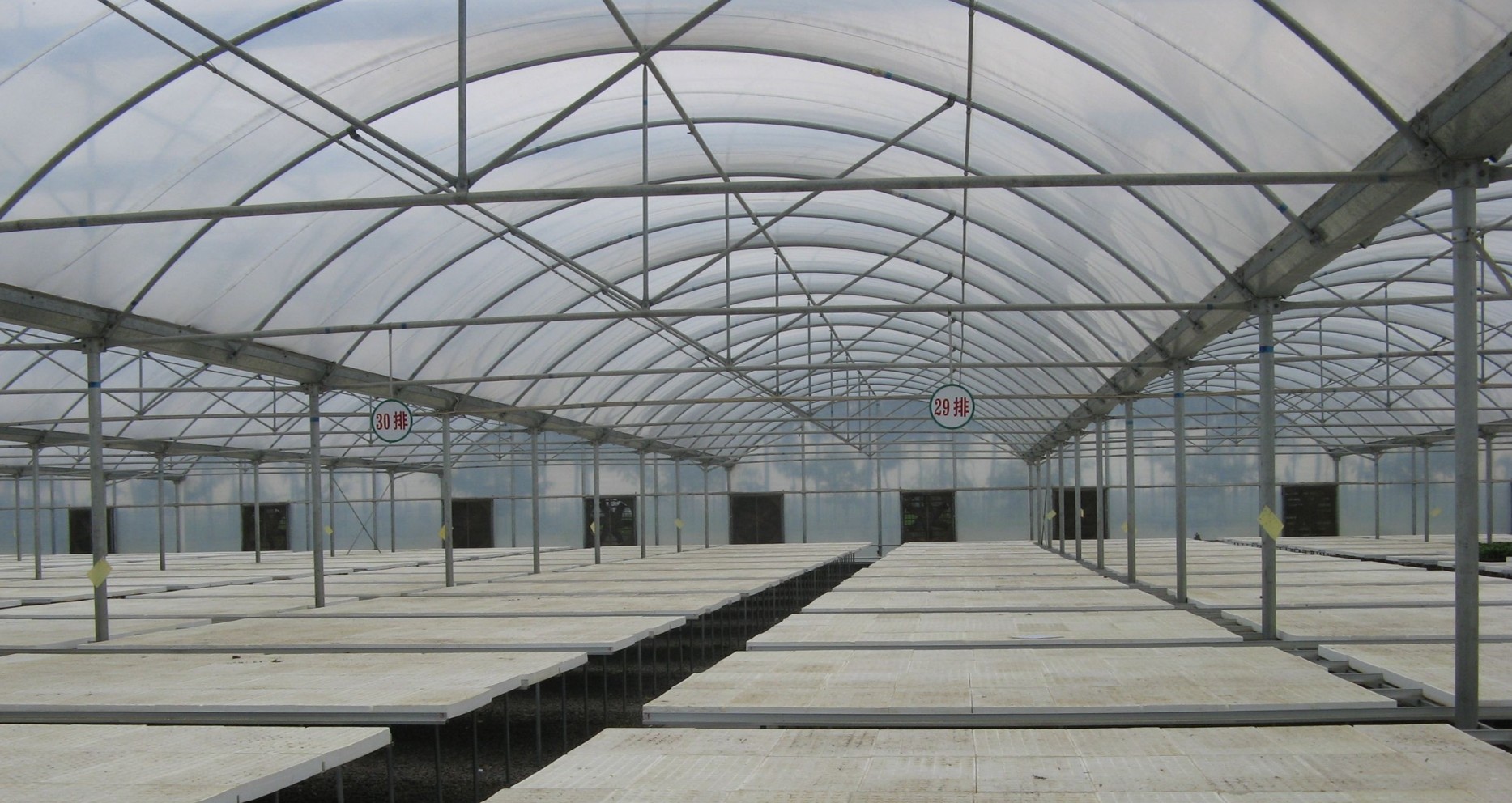
A complete modular system for film greenhouses
- External shading system: When light intensity exceeds the safe threshold for tomatoes, the external shading net automatically deploys to block excess heat and intense direct sunlight.
- Ventilation system: A natural ventilation system, consisting of roof and side vents, exhausts warm, humid air from the greenhouse. This is complemented by circulation fans that ensure uniform airflow, maintaining consistent and stable growing conditions.
- Fan-based cooling system: By utilizing water evaporation, this system continuously draws cool, fresh air into the greenhouse, helping to maintain temperatures within the optimal range for tomato growth—even during the sweltering summer months.
- Integrated water and fertilizer system: precisely controls the irrigation volume, EC value, and pH value of the nutrient solution, and delivers water and fertilizer directly to the tomato root zone via drip irrigation tape.
Related Products









Brand Trust
Brand Certification, Win-Win Cooperation
Construction Companies
We Provide Technical Design, Equipment Supply And Construction Coordination For Greenhouse Projects, Integrating Construction And Agricultural Technology Resources To Help Efficiently Complete Comprehensive Agricultural Projects.

Customized Precise Services
Our Technical Team Deeply Adapts To The Planting Needs Of Different Climate Zones And Crops, Providing You With a Full-Chain Customized Solution From Scheme Design To Operation And Maintenance Support.

Global Delivery Experience
Relying On Mature Experience Serving More Than 1,000 Customers In Over 90 Countries Worldwide, We Understand That Detailed Control Is The Core Guarantee Of Project Success, And We Can Efficiently Handle The Complex Scenarios And Delivery Requirements Of Overseas Projects.

/5