







Glass greenhouse 14
Double Glazed Glass Greenhouse
In cold climates, using double glazed glass greenhouses prevents excessive cooling of the walls—which could otherwise damage crops—thereby enabling year-round production.
Key Features:
Quantity
Minimum order quantity : 0
My Inquiry
add to the cart
Share
For growers in high-latitude, high-altitude, or extremely cold-winter regions, the instability of microclimates can directly impact cultivation, with winter heating costs accounting for the bulk of operational expenses. To address these critical pain points, Zheyang—a professional glass greenhouse supplier—has developed a double glazed glass greenhousesolution.
Why single-layered commercial glass greenhouses perform poorly during the depths of winter:
- The"cold wall"effect: In sub-zero weather, the temperature of a single-pane glass exterior wall can drop to near the freezing point, generating a strong flow of cold air. Within a range of 2–3 meters from the greenhouse perimeter, this can lead to stunted growth, delayed flowering, and root diseases.
- The conflict between thermal insulation and light transmission: During periods of severe cold in the daytime, heavy thermal curtains must be drawn to maintain temperature; this results in a 40%–50% loss of natural light for the crops—a reduction in light during the winter that directly translates to lower yields.
- High-temperature root scorch: To compensate for heat loss through single-pane glass, the hot water in the heating system must be heated to over 75°C–80°C. Heating pipes located near drainage channels or floor trenches create localized"dry-heat zones,"which cause scorching of the growing medium and the root system.
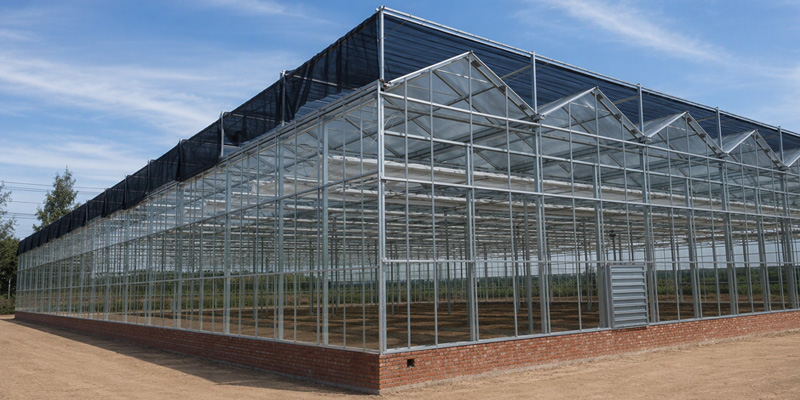
Zheyangdouble glazed glass greenhouseSolutions:
- Precision-engineered sealed glass units consist of two layers of high-strength tempered glass separated by an aluminum spacer containing a molecular sieve desiccant. This configuration reduces the heat transfer coefficient from 5.8 W/m²·K (for single-pane glass) to 2.6–3.0 W/m²·K, cutting conductive heat loss by approximately 40%–50%. In commercial cultivation of tomatoes, peppers, and floral crops, a combination of diffuse-light tempered glass (as the outer layer) and clear float glass (as the inner layer) is often used; this setup allows light to penetrate deep into the plant canopy while preventing the formation of harsh, intense shadows. Furthermore, double-glazed facades raise the temperature of the inner glass surface, eliminating cold downdrafts and ensuring that the entire growing area can be utilized fully and uniformly.
- Automated Internal Thermal Screen System: Designed for use with double-glazed greenhouse systems, these automated internal thermal screens deploy horizontally at the gutter level after sunset. Specialized reflective aluminum strips bounce more than 70% of long-wave infrared radiation back toward the crops, creating an insulating thermal layer above the crop canopy. During the day, the screens function as a high-light-transmission thermal barrier. The double-glazing significantly reduces overall heat loss, enabling the use of a low-temperature hot-water heating system, which effectively protects delicate root systems.
- High-load-bearing, snow-resistant structural framework: The aluminum glazing profiles feature integrated condensation channels that safely collect moisture and direct it toward perimeter drainage outlets. The structure is designed to securely support the additional permanent load imposed by double glazing, as well as significant potential snow loads, utilizing oversized hot-dip galvanized steel columns (Q235B/Q355B grade) and reinforced Venlo-style roof trusses.
Commercial application scenarios for double glazed glass greenhouses:
- High-yield vine crops: Indeterminate tomatoes, cucumbers, sweet peppers, and eggplants, maintaining consistent fruit set and yields throughout the year;
- Commercial hydroponic cultivation: Utilizing elevated trough-based growing systems, requiring precise temperature control and ensuring an absolute absence of overhead drips;
- High-end floriculture: Varieties such as cut roses, orchids, and gerbera daisies, requiring exceptional light uniformity as well as a clean, dry growing environment.
When sourcing commercial glass greenhouses from overseas, the primary concern for buyers is not minor scuffs on the steel framework, but rather the potential for the insulated glass units (IGUs) to shatter. These units—which weigh more than twice as much as single-pane glass—feature a sealed internal cavity, making them highly vulnerable to severe vibration, moisture, salt-spray corrosion, and the risk of tipping over during unloading. Zheyang Glass Greenhouse Supplier provides a comprehensive, end-to-end protection system for the entire shipping process.
- Fumigation-free, steel-reinforced wooden crates: Constructed from export-grade, fumigation-free plywood and secured with stamped, galvanized steel corner brackets, these crates offer high compressive strength and fully comply with global customs quarantine and phytosanitary standards.
- High-resilience, shock-absorbing internal cushioning: Professional anti-adhesion spacers are placed between the glass panes, while high-density shock-absorbing pads line the bottom and sides of the crate to dampen low-frequency resonance caused by transit vibrations.
- Customized corner protection: Each corner of the glass is fitted with a bespoke, impact-resistant guard to prevent breakage resulting from stress concentrations during handling or vibration.
Related Products









Brand Trust
Brand Certification, Win-Win Cooperation
Construction Companies
We Provide Technical Design, Equipment Supply And Construction Coordination For Greenhouse Projects, Integrating Construction And Agricultural Technology Resources To Help Efficiently Complete Comprehensive Agricultural Projects.

Customized Precise Services
Our Technical Team Deeply Adapts To The Planting Needs Of Different Climate Zones And Crops, Providing You With a Full-Chain Customized Solution From Scheme Design To Operation And Maintenance Support.

Global Delivery Experience
Relying On Mature Experience Serving More Than 1,000 Customers In Over 90 Countries Worldwide, We Understand That Detailed Control Is The Core Guarantee Of Project Success, And We Can Efficiently Handle The Complex Scenarios And Delivery Requirements Of Overseas Projects.

/5