The project site belongs to tropical monsoon climate with distinct wet and dry seasons:
‑ Wet season (June‑November): concentrated heavy rainfall, short‑term torrential rain, occasional typhoon peripheral gusts;
‑ Dry season (December‑May): strong ultraviolet solar radiation, high daytime temperature;
‑ Mountain terrain: sloping ground, uneven foundation condition, risk of surface water runoff during heavy rain.
Local mountain soil has low organic content, poor water‑fertilizer retention capacity, and a large number of soil‑borne pathogens. Under open‑field conditions, vegetables suffer flood damage, insect pests and fungal diseases frequently. Once typhoon‑related heavy rain arrives, open‑field vegetable production will face large‑scale crop failure. Simple local low‑cost shelters are unable to resist strong wind and heavy rain, with short service life and unstable internal growing environment.
The client is a local commercial agricultural investment farm, whose main requirements are as follows:
‑ Build large‑area cold greenhouse without heating system, realize year‑round leafy vegetable production, avoid production losses caused by seasonal heavy rain and typhoon weather;
‑ Adopt NFT hydroponic gutter system to bypass poor mountain soil, reduce soil‑borne diseases and pesticide usage;
‑ The steel structure must adapt to sloping mountain site, resist typhoon peripheral gust load and have good anti‑corrosion performance under high‑humidity tropical environment;
‑ Equip external shading system to lower indoor temperature during dry‑season strong sunlight period;
‑ Optimize roof drainage design to quickly discharge large amount of rainwater in wet season and prevent water ponding;
‑ Adopt modular components suitable for mountain transportation and on‑site assembly, lower the difficulty of foundation construction and installation;
‑ Control overall project investment, achieve good return on investment compared with high‑cost glass greenhouse;
‑ Realize basic fertigation automatic control, reduce daily manual management workload for farm workers.
This project faces multiple technical challenges brought by Philippine mountain tropical environment:
‑ Sloping mountain site brings difficulties to foundation treatment; the structure needs to deal with uneven settlement risk;
‑ Impact of typhoon peripheral gust: the polytunnel frame needs to meet corresponding wind‑load design requirements;
‑ Heavy seasonal rainfall: high requirements for roof drainage capacity to avoid rain leakage and ponding;
‑ Long‑term high‑temperature and high‑humidity environment, steel components face moisture corrosion risk;
‑ Intense solar radiation in dry season, high indoor temperature easily occurs without effective shading measures;
‑ Mountain road condition limits transportation of oversized components, requiring modular split‑type design;
‑ Hydroponic NFT system needs stable water circulation under high‑temperature tropical condition to avoid root‑rot risk for leafy vegetables.
5.Technical Solution Provided by Cangzhou Zheyang Agricultural Technology
In response to mountain terrain, tropical monsoon climate and customer’s hydroponic planting demand, Cangzhou Zheyang Agricultural Technology provided a complete customized multi‑bay polytunnel cold greenhouse turn‑key solution. Considering the local typhoon risk, sloping ground and mountain transportation restrictions, we did not adopt standard flat‑ground greenhouse design. All subsystems are adjusted according to actual site survey information, to guarantee stable production, reliable structure and convenient construction in Philippine mountain farm conditions.
5.1 Structural System
‑ Hot‑dip galvanized steel framework, zinc coating ≥275 g/m² for anti‑corrosion under tropical high‑humidity atmosphere;
‑ Reinforced arch frame and column connection structure, specially calculated for typhoon peripheral gust wind load;
‑ Modular split components, convenient for mountain‑area transport and hoisting;
‑ Optimized structural design adaptable to sloping site, guiding customer to do step‑by‑step foundation treatment to reduce uneven‑settlement risk;
‑ Enhanced roof gutter drainage system for fast rainwater discharge during heavy downpour;
‑ Design lifespan: 10‑14 years.
5.2 Covering System
‑ High‑durability anti‑UV anti‑drip PO plastic film;
‑ Diffused light performance, soften strong tropical sunlight;
‑ Anti‑condensation treatment to reduce inner water dripping onto crops;
‑ Anti‑ageing formulation adapted for long‑term tropical outdoor exposure.
5.3 Climate Control System (Cold Greenhouse, no heating unit)
‑ External shading system: motorized external sun‑shade net, reduce indoor temperature under strong sunlight in dry season;
‑ Natural ventilation: side roll‑up ventilation system for large‑volume air exchange, release indoor heat and moisture;
‑ Circulation fans installed inside the tunnel: improve air flow, reduce local high‑humidity area and lower fungal disease pressure;
‑ No heating system: local mountain temperature meets leafy vegetable growth demand all year round.
5.4 Hydroponic System
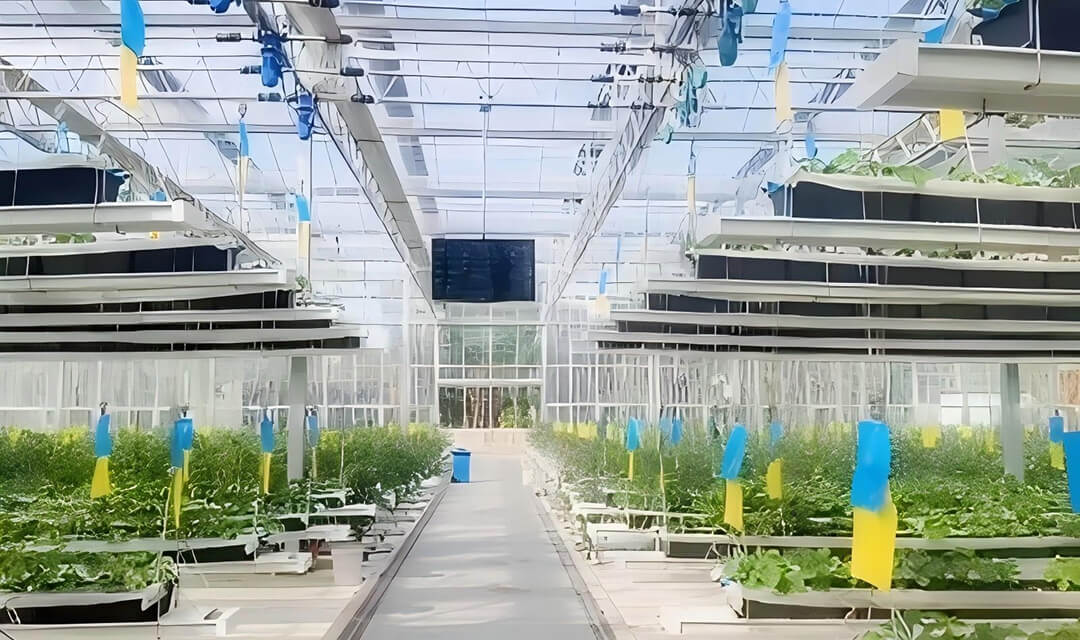
‑ Anti‑UV PVC NFT hydroponic growing gutter system with height‑adjustable support stands;
‑ Drip & NFT circulating fertigation unit with automatic EC & pH monitoring for nutrient solution;
‑ Complete collection, filtration and water recycling system, improve water utilization efficiency;
‑ Modular gutter assembly, easy for on‑site installation on mountain farm;
‑ Suitable high planting density for leafy greens, convenient for sowing, management and harvesting work.
5.5 Automation System
‑ Simplified centralized control cabinet;
‑ Real‑time monitoring of indoor temperature and humidity, nutrient solution EC and pH value;
‑ Automatic scheduling for nutrient solution circulation according to crop growth stage and ambient temperature;
‑ Simple alarm reminder for equipment abnormal status.
6. Customer Feedback
The customer gave positive feedback on structural stability, mountain‑adapted design and hydroponic system delivery:
“This polytunnel cold greenhouse performs reliably in our mountain farm under Philippine wet‑season heavy rain and typhoon‑peripheral wind. The external shading and ventilation system keep suitable growing conditions for leafy greens. The NFT hydroponic gutter system helps us get stable clean vegetables without being limited by poor local mountain soil. Cangzhou Zheyang Agricultural Technology delivered practical solutions tailored for our mountain‑site challenges.”
FAQ – Philippines Mountain Polytunnel Cold Greenhouse Project
Q1: Is polytunnel cold greenhouse suitable for mountain farm in typhoon‑affected areas such as the Philippines?
Yes. With hot‑dip galvanized reinforced structure, wind‑load optimized calculation and proper foundation construction, polytunnel cold greenhouse can resist typhoon peripheral gusts. For this Philippines mountain project, Cangzhou Zheyang Agricultural Technology completed dedicated wind‑load simulation according to local meteorological data, instead of applying universal standard design. Compared with glass greenhouse, it has obvious cost advantages for large‑scale leafy vegetable planting in tropical mountain areas, and its structural reliability is far better than local simple plastic shelters.
Q2: How does cold greenhouse control high temperature without heating or pad‑fan cooling system?
This cold greenhouse adopts motorized external shading, large‑area side roll‑up natural ventilation and internal circulation fans. Zheyang Agriculture’s engineering team matched the equipment capacity according to local peak temperature data of the Philippine mountain site, these modules work together to discharge indoor heat and moisture, to maintain proper growing temperature for leafy vegetables in tropical mountain conditions. This low‑cost climate solution has been verified by real‑world operation of this Philippine project.
Q3: Why choose NFT hydroponic gutter system for Philippine mountain farms?
Local mountain soil has low fertility and many soil‑borne pathogens. NFT hydroponic planting completely isolates crops from native soil, realizes precise nutrient management and water recycling. It increases yield, reduces pesticide usage and improves vegetable quality. For this project, Zheyang Agriculture supplied full‑set anti‑UV PVC NFT gutters together with supporting circulation & monitoring system, and provided on‑site installation guidance for local team, helping the farm quickly achieve stable commercial production.
Q4: What full‑chain support can Zheyang Agriculture provide for overseas mountain greenhouse projects?
Cangzhou Zheyang Agricultural Technology delivers end‑to‑end service for overseas projects: including site‑adapted custom engineering design, modular component manufacturing, international logistics coordination, installation guidance, system commissioning guidance, long‑term technical consultation and spare‑parts supply support. For complex mountain terrain such as the Philippines, our team will adjust component splitting and packaging scheme to adapt difficult mountain transportation conditions, avoiding troubles caused by coordinating multiple separate suppliers.
Q5: Can Zheyang Agriculture share similar completed tropical polytunnel project references for our pre‑project evaluation?
Yes. Zheyang Agriculture owns multiple delivered real‑case references across Southeast Asia and Pacific tropical regions, including mountain polytunnel cold greenhouses, cyclone‑resistant multi‑span film greenhouses and matching hydroponic systems. Upon request, our team can share verified project photos, key operational data and customer feedback for your reference, to support your project planning and budget assessment.
If you are planning polytunnel greenhouse or hydroponic projects in tropical regions,
Contact Cangzhou Zheyang Agricultural Technology to get customized greenhouse solutions and quotation.