



2026-10-14
What ventilation methods are used for agricultural glass greenhouses?
Many overseas clients invest heavily in agricultural glass greenhouses, only to encounter frequent problems during the summer months:
- Stifling heat and oxygen deficiency: Midday temperatures inside the greenhouse can easily exceed 40°C; however, crops such as tomatoes and peppers stop setting fruit at temperatures above 35°C, leading to an immediate yield loss of 20%–30%.
- Excessive humidity: In a sealed environment, relative humidity often remains above 85% for extended periods, triggering widespread outbreaks of gray mold and downy mildew and causing pesticide costs to skyrocket.
- CO₂ deficiency: A shortage of the raw materials needed for photosynthesis results in small fruit and low sugar content, preventing the produce from fetching a good market price.
- Excessive humidity: In a sealed environment, relative humidity often remains above 85% for extended periods, triggering widespread outbreaks of gray mold and downy mildew and causing pesticide costs to skyrocket.
- CO₂ deficiency: A shortage of the raw materials needed for photosynthesis results in small fruit and low sugar content, preventing the produce from fetching a good market price.
Ventilation is the greenhouse's "second lifeline," second only to light exposure. It simultaneously addresses three critical issues: cooling, dehumidification, and air replenishment. However, different climates, crops, and scales require vastly different ventilation strategies—choosing the wrong one can result in hundreds of thousands in wasted expenditure without achieving the desired results. Below, we outline various ventilation methods to help overseas users make the right choice for their specific needs.
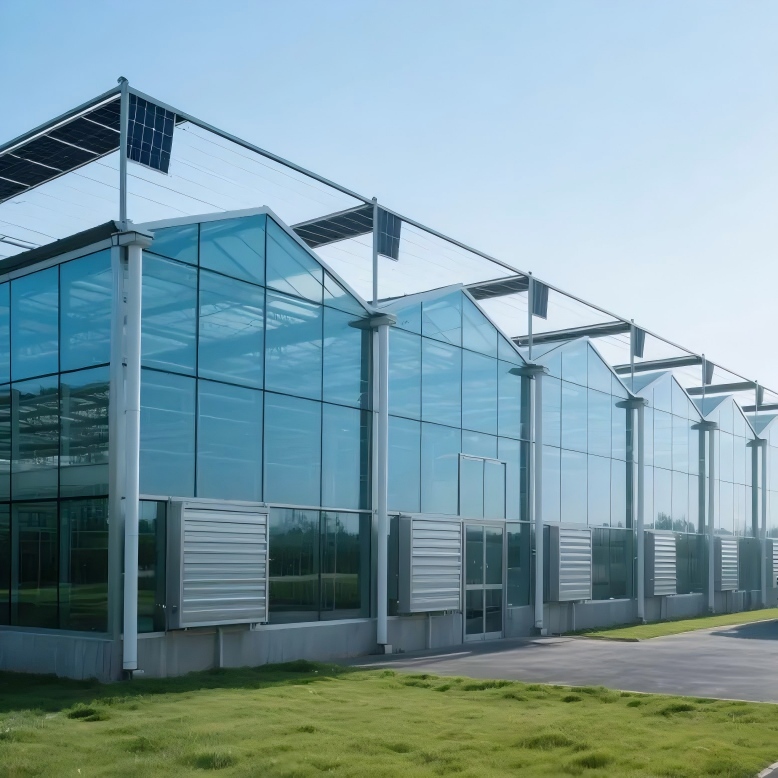
Natural ventilation via roof vents operates on the principle of thermal buoyancy (the "chimney effect"): warm air rises and escapes through open roof vents. This is the most fundamental and cost-effective ventilation solution for agricultural glass greenhouses. It consumes virtually no electricity during operation, entails minimal maintenance, and features a simple structure, making it ideal for small-to-medium-sized greenhouses in regions with mild climates. When outdoor temperatures are not consistently extreme, roof vents effectively remove hot air, lower indoor humidity, and inhibit the proliferation of fungal diseases. The downside is that performance depends heavily on outdoor wind and weather conditions; cooling capacity is limited during still, sultry weather.
Natural ventilation via side vents utilizes a combination of wind pressure and thermal buoyancy to create airflow, allowing fresh air to enter through side windows while displacing warm, humid air from within. The airflow path stays closer to the crop canopy, directly ventilating the plant zone and improving the air environment at the lower levels. In regions with consistent winds, combining side vents with roof vents significantly boosts ventilation efficiency—again, without continuous power consumption—while keeping hardware costs low and simplifying installation and commissioning. However, relying solely on side vents offers limited overall cooling in hot, windless conditions and struggles to cope with sustained extreme heat.
Continuous ridge vents represent an upgraded natural ventilation design; the entire ridge section can be opened over a large area, providing a much larger ventilation opening than standard independent roof vents. Their advantages include high exhaust volume and faster hot air discharge, resulting in superior cooling performance compared to standard vents; they are well-suited for large agricultural glass greenhouses in hot, rainy tropical and subtropical regions. The large-opening design allows for rapid adjustment of indoor CO₂ concentrations, meeting the photosynthetic demands of high-density cash crops. They can be paired with motors for automated opening and closing, facilitating integration into smart greenhouse control systems; the only drawback is that the equipment cost is higher than that of standard roof vents, and there are specific requirements regarding the structural strength of the greenhouse frame.
The wet pad and fan system is a forced evaporative cooling solution; it relies on fans to extract air from the greenhouse, drawing outdoor air through moistened pads and utilizing the heat absorption of water evaporation to deliver cool air into the interior. Its core advantage is superior cooling capacity, capable of consistently lowering indoor temperatures by 10–15°C; it is particularly effective in arid, high-temperature regions—such as the Middle East or the southern United States—where summers are scorching and dry. This system offers stable airflow independent of outdoor wind conditions, ensuring continuous ventilation and cooling even on windless days, making it suitable for large-scale commercial cultivation of high-value crops. Drawbacks include continuous power consumption and the need for a reliable water source; additionally, indoor humidity levels rise, so caution is advised when using this system in isolation in humid or rainy regions.
Internal circulation fans do not introduce fresh outdoor air; instead, their primary function is to agitate the air within the greenhouse, eliminating pockets of stagnant temperature or humidity. They serve an auxiliary, reinforcing role—while they cannot achieve significant cooling on their own, when paired with roof vents or wet pad and fan systems, they ensure more uniform temperature and humidity throughout the agricultural glass greenhouses, preventing localized overheating or excessive humidity and reducing the incidence of disease. Circulation fans are energy-efficient and offer flexible installation, making them common in wide-span glass greenhouses and seedling nurseries; they also promote the evaporation of moisture from leaf surfaces, preventing prolonged condensation. However, they cannot serve as the primary ventilation system and should only be used as a supplementary solution.
Integrated ventilation systems combine roof vents, side vents, circulation fans, and wet pad and fan systems into a single smart control framework, automatically switching between different ventilation components based on real-time monitoring of temperature, humidity, and outdoor wind speed. The primary advantage of this system is its exceptional year-round adaptability; it automatically adjusts ventilation strategies across all four seasons—activating evaporative cooling pads and fans during high temperatures while relying solely on natural roof vents during mild weather—thereby balancing crop performance with energy efficiency. Featuring a high level of automation, the system significantly reduces the need for manual inspections and operations while consistently maintaining the ideal growing environment for crops, making it well-suited for high-standard commercial cultivation facilities. However, the initial investment is relatively high, and the system requires a professional team for design, installation, and commissioning.