







2026-10-26
An Introduction to the Origins of Commercial Tempered Glass Greenhouses
Before the advent of commercial tempered glass greenhouses, agricultural growers relied on simple plastic-covered structures. While these were low-cost, they could not meet the rigorous demands of large-scale, profit-oriented crop production. Through continuous research and development, we identified a structural design that maximizes access to natural light while offering robust stability, an integrated ventilation system, and ample growing space. By replacing traditional glass with tempered glass, we arrived at what is now known as a tempered-glass greenhouse.
Pain points faced by commercial growers:
Extreme weather: High winds, heavy snowfall, hail, prolonged torrential rain, and intense heatwaves can damage greenhouses and jeopardize entire crops.
Insufficient or uneven light: Poor light transmission, sunscald (burns) on produce, and uneven light distribution can negatively impact both the appearance and quality of the harvest.
Difficulty in humidity control: Condensation dripping onto leaves and fruit, combined with high-humidity conditions, fosters the growth of mold, gray mold (Botrytis), and powdery mildew. This often necessitates frequent pesticide application, which can lead to produce failing to meet safety standards for pesticide residues.
Inability to ensure stable production: An uncontrollable environment—with temperatures that drop too low in winter or climb too high in summer—makes it difficult to reliably fulfill orders.
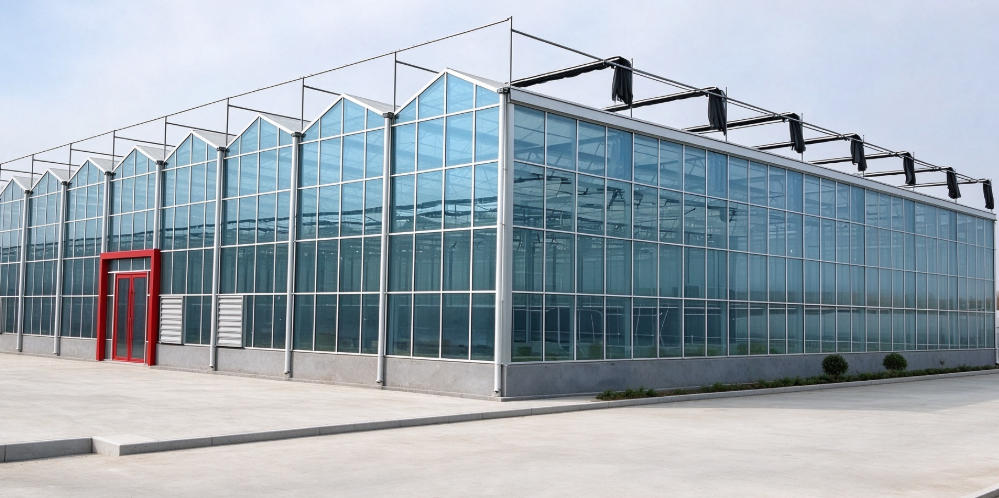
With a commercial tempered glass greenhouse, none of these will be an issue.
To address extreme weather, we analyze the wind and snow loads specific to the farm’s location and utilize a primary framework made of hot-dip galvanized steel to ensure structural stability. The structure is clad in specialized tempered glass, which is highly resistant to breakage, even during hailstorms. An integrated aluminum alloy sealing system provides superior waterproofing, protecting crops from weather-related damage.
Regarding light exposure, tempered glass maintains a consistently high light transmission rate over long periods, ensuring optimal photosynthesis. With a service life of 20–25 years, it eliminates the need for frequent replacement—offering excellent cost-effectiveness while enhancing the visual appeal of the agricultural produce.
For humidity control, we install dedicated condensate collection channels beneath the glass panels to capture moisture that forms on the inner surface, draining it outside via a piping system. Keeping plant surfaces dry reduces the risk of disease, thereby lowering the need for pesticide application; this not only ensures food safety but also reduces operational costs. The tempered glass greenhouse features a natural ventilation system at the roof, complemented by side vents, to facilitate efficient air exchange and maintain humidity levels within an ideal range.
To mitigate production instability, our multi-span glass greenhouses can be equipped with external shading systems to block excessive solar heat during the summer, as well as cooling systems to rapidly lower indoor temperatures. In the winter, heating systems can be added to maintain optimal growing temperatures and minimize heat loss. These integrated systems enable growers to maintain stable, year-round production, making it possible to fulfill long-term commercial orders.
FAQ
Q1: What is the service life of the commercial tempered glass greenhouse?
A: The hot-dip galvanized steel frame can last more than 20 years. Tempered glass can serve 20–25 years. Consumables like shading screens, motors and rubber seals need replacement every 5–8 years.
Q2: Should I choose single-layer tempered glass or double insulated glass for my tempered glass greenhouse?
A: Single low-iron tempered glass delivers maximum light, ideal for warm climates, tomato, flower planting. Double hollow insulated glass has excellent heat preservation, suitable for cold zones with long winters, reduces heating consumption.
Q3: What information do I need to provide if I want to customize a multi-span glass greenhouse?
A: You need to tell us your required size and land situation, local climate conditions, crop type, preferred glass type, supporting systems you need, destination port and your budget. With these details, our engineering team can make proper drawings and an accurate quotation for you.


