



2026-11-09
How Commercial Multi-Span Greenhouses Withstand Storms
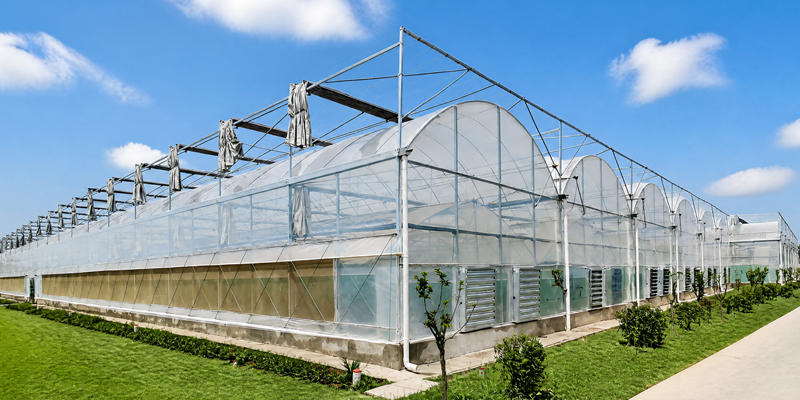
In the field of commercial horticulture, catastrophic structural failure is a major concern for every grower. A sudden blizzard or a powerful tropical storm can—in a matter of minutes—destroy greenhouse coverings, cause steel frameworks to collapse, and result in the total loss of crops. Last year, a severe snowstorm struck Eastern Europe and Central Asia; the heavy accumulation of snow caused many standalone arch-style greenhouses to buckle under the pressure. In contrast, the commercial multi-span greenhouses designed by Zheyang remained structurally intact under these extreme weather conditions, with the crops inside left completely unaffected.
Principles by which commercial multi-span greenhouses resist wind and snow:
- Arched Roof Structure: Traditional semi-circular roofs feature a relatively flat top, which is prone to the accumulation of heavy, damp snow. As snow piles up on the peak, it creates a dangerous downward pressure. Zheyang’s multi-span greenhouses utilize a Gothic-style pointed arch structure; the steep angle of the roof prevents snow from settling, allowing it to slide off naturally under the force of gravity, thereby eliminating the buildup of static snow loads.
- High-strength structural steel: Precisely calculated based on local 50-year wind and snow load data, the steel is hot-dip galvanized to prevent the formation of minor rust at critical bolted connections, ensuring it retains 100% of its yield strength even when exposed to long-term, high-humidity environments. Continuous longitudinal and transverse trusses form an integrated, three-dimensional spatial framework, which eliminates localized stress concentrations.
- High-capacity gutter system: Features high-strength extruded aluminum alloy channels paired with high-tensile, plastic-coated corrugated clamping strips. This configuration provides continuous securing, preventing wind from penetrating the edges and effectively ensuring that the covering material is not lifted or blown away.
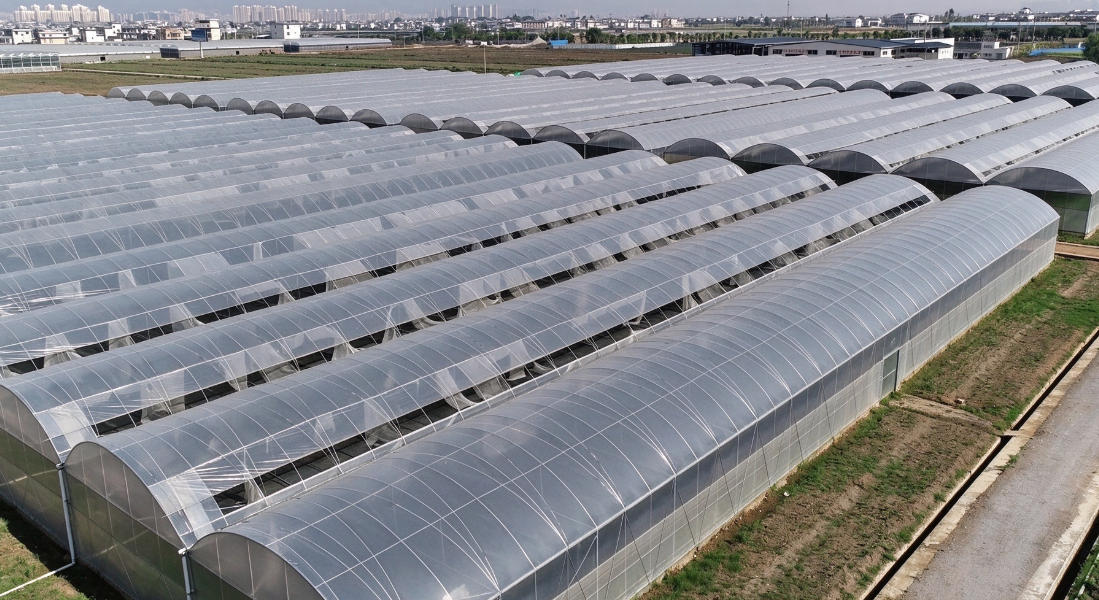
In regions that experience heavy winter snowfall—such as northern North America, Eastern Europe, Central Asia, Japan, and South Korea—conditions are often accompanied by wind gusts reaching 90–120 km/h. As a premier commercial greenhouse supplier, Zheyang recommends a commercial multi-span greenhouses design featuring a Gothic-style peaked roof, double-layer the inflatable PO film, and snow-melting pipes installed in the gutters. This configuration provides exceptional resistance to wind and snow, offering the following advantages during operation:
- Low wind resistance: An inflation system maintains a slight positive pressure of 50–110 Pa between the two layers of the membrane, keeping the outer layer taut, firm, and smoothly rounded—much like the surface of a drum. When strong winds blow, the airflow glides over the surface, effectively preventing the edge tearing that can occur in single-layer membranes when they flap violently against their supporting framework during high winds.
- Rapid Snow Melting in Gutters: Circulating hot-water pipes are installed at the bottom of the gutters, ensuring that any snow sliding into them melts quickly and drains away. This prevents the structural framework from being subjected to sustained snow loads; furthermore, the absence of any flat areas on the peaked roof means that heavy snow slides down the steep slopes and directly into the gutters on either side.
FAQ
Q1: "What is the specific difference between Gothic Arch and Round Arch multi-span greenhouse?"
Q1: "What is the specific difference between Gothic Arch and Round Arch multi-span greenhouse?"
A: A traditional round arch has a flat curvature radius at the apex, allowing snow to accumulate and form a dense ice core. A Gothic arch features a pointed ridge with a steep initial pitch (typically 28°–32°). This creates natural gravitational slippage, causing snow to slide into the perimeter gutters before it can compact into an overload condition, while also providing better condensation runoff along the inner film surface.
Q2: "What steel grade and galvanization standard do you use to ensure the frame doesn’t weaken over time?"
A: We utilize certified structural steel grades Q235B and Q355B (equivalent to ASTM A36 / European S235 & S355). All steel components undergo post-fabrication hot-dip galvanization in accordance with ISO 1461 / ASTM A123 standards, delivering a zinc coating thickness of 275 g/m² to 450 g/m² (45–65 microns). Every profile is 100% pre-punched and pre-drilled prior to galvanization, requiring zero on-site welding or drilling that could expose raw steel to corrosion.
Q3: "Can this storm-resilient frame still support internal crop trellising loads?"
A: Yes. Structural loads in commercial facilities are cumulative. When designing for hanging crops (tomatoes, cucumbers, peppers), our engineers add dedicated horizontal crop-support V-trusses and overhead longitudinal high-tensile trellis wires designed to support 15 to 25 kg/m² of suspended plant weight, with structural calculations combining both full crop hanging loads and maximum external environmental wind/snow pressures simultaneously.
Q4: "If I provide my farm's GPS coordinates, how long does it take for your team to provide a preliminary structural layout and quotation?"
A: Once you share your target land dimensions, desired crop, and GPS coordinates/city name, our engineering department retrieves localized 30-year meteorological data (wind speed, snow load, temperature extremes) and delivers a preliminary 3D structural layout, cross-sectional specification sheet, and itemized quotation within 2 to 3 business days.As a commercial greenhouse supplier, Zheyang provides users with actionable, customized solutions.