







Fundamental Differences Between Commercial-Grade Greenhouses and Standard Small Hoop Houses
Zheyang Commercial Greenhouse Solutions:
In multi-span greenhouses, the gutter height is increased to between 4.5 and 6.0 meters, creating a substantial air buffer space. Combined with roof ridge vents and external shading nets, this allows hot air to be vented directly out, effectively lowering the indoor temperature without the need for an air-conditioning system.
At each span junction of the multi-span greenhouse, an extra-large, heavy-duty hot-dip galvanized steel gutter is installed. Rainwater collecting on the roof is rapidly channeled into a peripheral drainage system; once treated, this water can be repurposed for automated drip irrigation and fertigation systems, enabling effective resource recovery and reuse.
Sealed lateral ventilation channels are equipped with UV-resistant insect screens, and a positive-pressure airlock is installed at the entrance. This effectively prevents the entry of pests, reduces the need for pesticide application, and ensures compliance with retail standards.
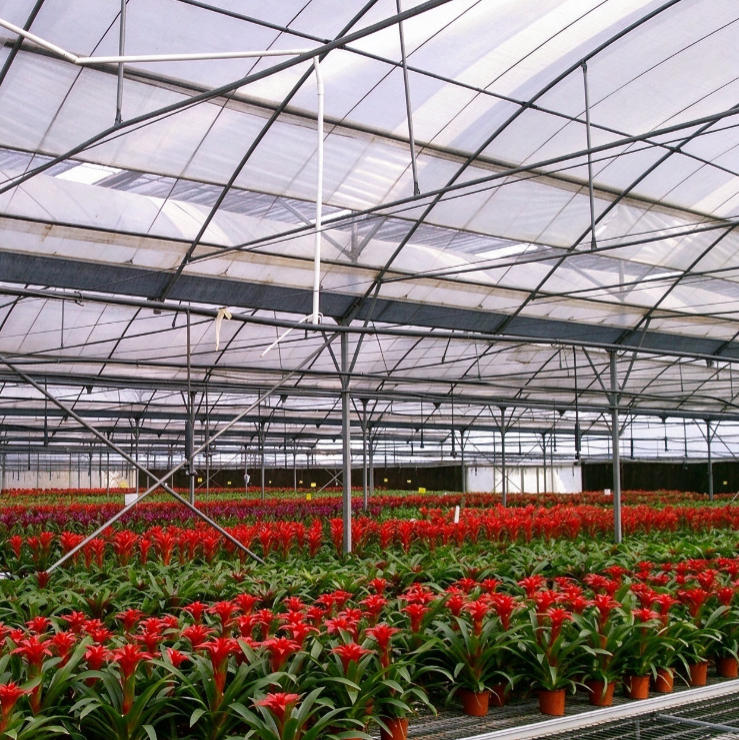
- Lowland plain regions: With year-round temperatures of 32°C–38°C and humidity levels exceeding 80%, multi-span film greenhouses—featuring a gutter height of 5.0 meters, external ridge-mounted shading nets, and gutters with a steep slope—can maintain a well-ventilated, cool environment without the need for air conditioning.
- Highland regions: At an altitude of 1,200m–1,500m, with daytime temperatures of 22℃–27℃ and nighttime temperatures of 12℃–16℃—characterized by abundant sunlight but extremely high levels of ultraviolet radiation—multi-span film greenhouses can achieve high-yield results, reaching over 90% of the potential yield capacity for these highland areas.
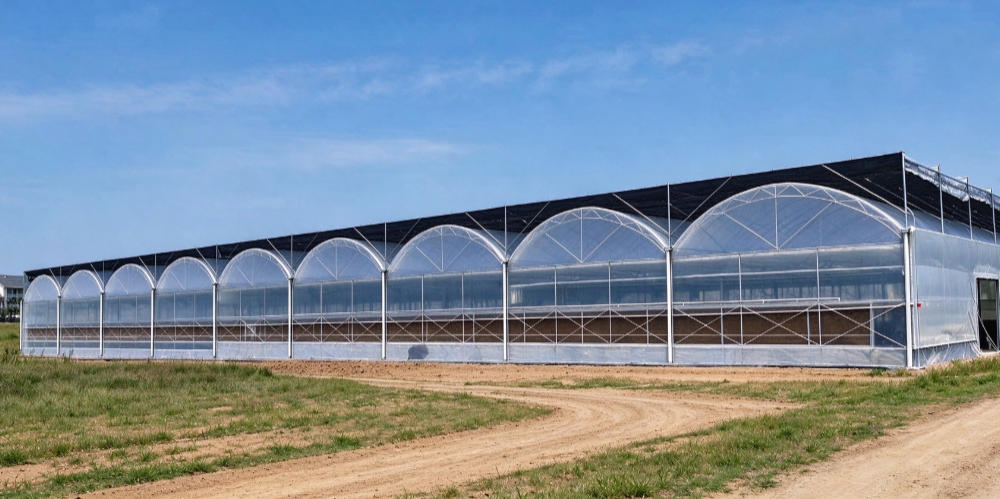
Q1: What are the advantages of using naturally ventilated multi-span greenhouses in hot and humid tropical climates?
Answer: In high-altitude regions, nighttime temperatures are lower and relative humidity levels are moderate. By utilizing industrial-grade multi-span greenhouses—featuring high gutters (5.0 meters), automated ridge vents, and external shading systems—it is possible to achieve effective natural cooling at a low cost, without the need for electric ventilation fans.
A: Water evacuation is engineered from the roof down. Unlike standalone hoop tunnels that dump water onto adjacent soil, our multi-span greenhouses connect bays with oversized cold-formed, hot-dip galvanized steel gutters engineered to slope into heavy-duty PVC or steel downspouts. Runoff capacity is calculated to handle extreme precipitation spikes up to 120–150 mm/hour without internal gutter overtopping.
A: All steel columns, arch trusses, gutters, and hardware are 100% pre-fabricated with CNC automated punching in our manufacturing facility. Components are tightly packed into 40ft High Cube containers for ocean freight to major regional ports. Assembly is completely modular. We provide complete 3D CAD blueprints, step-by-step video manuals, and can dispatch bilingual project supervisors for on-site commissioning.


