







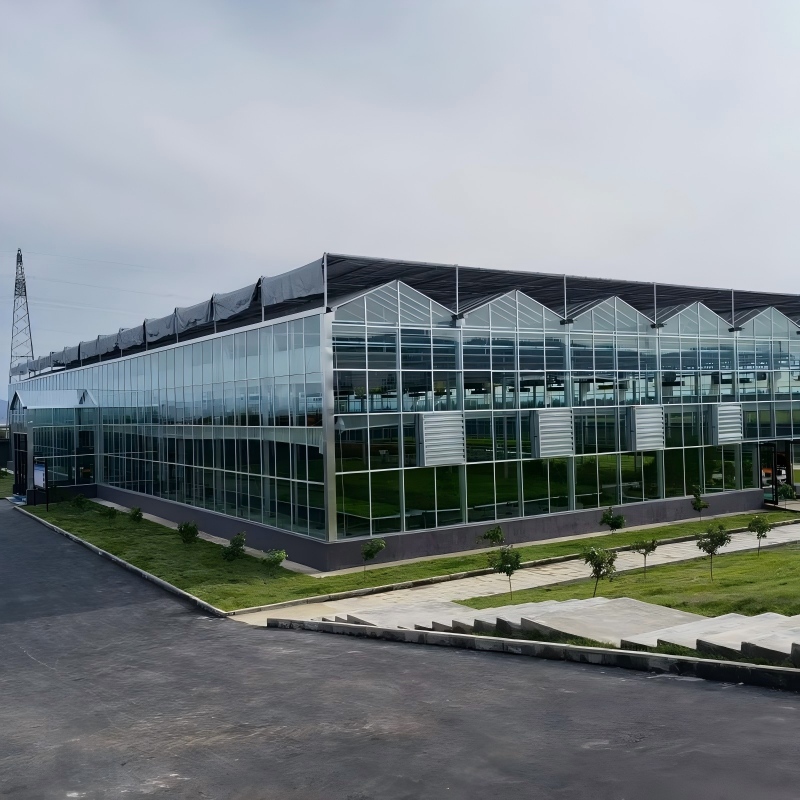
What Are the Applications of High-End Glass Greenhouses?
Chapter 1: Why Are More Commercial Projects Choosing High-End Glass Greenhouses?
With the development of modern agriculture toward large-scale, intelligent, and efficient production, commercial greenhouse projects have increasingly higher requirements for growing environments, production efficiency, and long-term operation.Compared with traditional film greenhouses, high-end glass greenhouses have become a preferred choice for large agricultural projects, premium crop production, and smart agriculture applications due to their excellent light transmission, reliable structural design, and advanced environmental control capabilities.
A high-end glass greenhouse is not just a cultivation space, but a comprehensive solution integrating structural systems, climate control, and agricultural management. Through professional design and proper configuration, glass greenhouses help investors improve production stability, reduce long-term operating costs, and increase overall project value.
Better Light Conditions Improve Crop Production Quality
Light availability is one of the most important factors affecting crop growth. High-end glass greenhouses typically use high-transmission glass as the covering material, providing crops with a more stable and sufficient natural lighting environment compared with traditional materials.
Excellent light transmission improves photosynthesis efficiency and supports better crop growth cycles and quality, making glass greenhouses particularly suitable for vegetables, flowers, and high-value crops with higher lighting requirements.
In addition, glass greenhouse designs can integrate shading systems and supplemental lighting solutions to adjust the light environment according to seasonal changes and crop requirements, enabling more precise cultivation management.
Precise Environmental Control Meets Modern Agricultural Requirements
Modern commercial agriculture requires increasingly stable production environments. High-end glass greenhouses can use intelligent control systems to precisely manage key factors such as temperature, humidity, ventilation, and CO₂ concentration, creating optimal growing conditions for crops.
For example, in cold regions, heating and insulation systems can reduce the impact of low temperatures, while in hot climates, ventilation, shading, and cooling systems help maintain suitable growing conditions.
This highly controlled production model reduces the impact of external climate changes and improves year-round cultivation capabilities.
Longer Service Life Improves Long-Term Investment Value
For commercial investment projects, greenhouses must not only meet current production needs but also provide stable long-term operation. High-end glass greenhouses generally use durable steel structures and glass covering systems, offering longer service life and lower maintenance requirements.
Compared with temporary greenhouse structures, glass greenhouses are more suitable for large agricultural projects with long-term development plans. Although the initial investment may be higher, improved production efficiency, reduced maintenance costs, and upgrade flexibility can create greater returns over the project lifecycle.
Therefore, for investors seeking stable, efficient, and sustainable agricultural production systems, high-end glass greenhouses offer significant long-term value.
High-End Glass Greenhouses Become an Important Choice for Modern Agricultural Projects
As agriculture continues to evolve, commercial projects are shifting from simple cultivation spaces toward comprehensive production solutions. With advantages such as high light transmission, intelligent control, structural stability, and long-term operational value, high-end glass greenhouses are increasingly adopted by large-scale agricultural projects.
Zheyang Agriculture, as a professional greenhouse design and manufacturing supplier in China, provides tailored glass greenhouse solutions based on customer project requirements. Instead of offering standardized greenhouse products, Zheyang Agriculture develops solutions according to local climate conditions, crop requirements, and investment objectives, providing complete services from design and manufacturing to delivery.
Through professional engineering expertise and manufacturing capabilities, Zheyang Agriculture helps global customers build more efficient, reliable, and sustainable commercial greenhouse systems.

Chapter 2: What Are the Main Applications of High-End Glass Greenhouses?
With the continuous development of modern agricultural technology, high-end glass greenhouses are now widely applied in various fields, including commercial farming, smart agriculture, research facilities, and ecological projects.Compared with traditional greenhouse systems, high-end glass greenhouses not only provide stable growing environments but also integrate automated control technologies for more precise and intelligent agricultural management.
Due to their excellent light transmission, structural stability, and scalability, high-end glass greenhouses are especially suitable for projects that require high production efficiency, precise environmental control, and long-term operational value.
Large-Scale Commercial Crop Production
Commercial agriculture is one of the most important application areas for high-end glass greenhouses. For large-scale vegetable farms, premium fruit production projects, and flower cultivation facilities, a stable growing environment is essential for improving crop yield and quality.High-end glass greenhouses create suitable growing conditions through integrated management of temperature, humidity, lighting, and ventilation. Their high light transmission capability also allows crops to make better use of natural sunlight and improve photosynthesis efficiency.
In commercial cultivation projects, glass greenhouses can be combined with automated irrigation, fertilization, and intelligent control systems to support large-scale production, reduce labor costs, and improve operational efficiency.
Smart Agriculture Demonstration Projects
As agriculture becomes increasingly digitalized, more smart agriculture projects are adopting high-end glass greenhouses as platforms for both production and technology demonstration.
By integrating intelligent environmental control systems, glass greenhouses can monitor and adjust key parameters in real time, including:
- Temperature control;
- Humidity management;
- Lighting adjustment;
- CO₂ concentration management;
- Automated irrigation.
This intelligent management approach improves production efficiency while also helping companies demonstrate advanced agricultural technologies. It is widely used in modern agricultural parks, agricultural technology centers, and government-supported demonstration projects.
Research and Breeding Greenhouses
Research and breeding projects require highly precise environmental conditions. With stable structures and adjustable climate systems, high-end glass greenhouses provide reliable environments for scientific research.
Common research applications include:
- New plant variety development;
- Crop growth experiments;
- Climate adaptation studies;
- Agricultural technology testing.
Compared with traditional greenhouse systems, high-end glass greenhouses allow researchers to control experimental conditions more accurately and reduce the impact of external environmental changes. Their modular design also makes it easier to integrate professional research equipment for different project requirements.
Agricultural Tourism and Ecological Exhibition Projects
Beyond agricultural production, high-end glass greenhouses are increasingly used in agricultural tourism, ecological exhibitions, and urban farming projects.
With modern architectural design and comfortable interior spaces, glass greenhouses can be developed into:
- Botanical gardens;
- Ecological restaurants;
- Agricultural theme parks;
- Urban indoor farming spaces.
These projects focus not only on agricultural functions but also on visitor experience and commercial value. Through transparent structures and open designs, high-end glass greenhouses combine production, education, and leisure activities, creating multiple revenue opportunities.
Selecting the Right Glass Greenhouse Solution for Different Projects
Different applications have different requirements for greenhouse systems. Therefore, selecting the right structure and configuration is essential when developing high-end glass greenhouse projects.
For example:
- Large commercial farms focus more on productivity and automation;
- Research projects require higher environmental control accuracy;
- Smart agriculture projects need stronger data management capabilities;
- Ecological exhibition projects emphasize spatial design and visual experience.
Therefore, professional greenhouse suppliers should provide project-specific solutions based on local climate conditions, crop requirements, and investment objectives rather than simply offering standardized products.
Zheyang Agriculture: High-End Glass Greenhouse Solutions for Various Applications
The value of high-end glass greenhouses lies not only in their structures but also in their ability to adapt to different agricultural applications.
Zheyang Agriculture, as a professional greenhouse design and manufacturing supplier in China, provides tailored glass greenhouse solutions based on specific customer requirements.Whether for commercial farming bases, smart agriculture parks, research facilities, or ecological exhibition projects, Zheyang Agriculture delivers complete services from design and manufacturing to project delivery.With professional engineering capabilities and extensive manufacturing experience, Zheyang Agriculture helps global customers build more efficient, reliable, and sustainable high-end greenhouse systems.
Chapter 3: How to Select the Right High-End Glass Greenhouse for Different Projects?
For commercial glass greenhouse projects, selecting the right greenhouse solution is not simply about comparing product specifications. It requires a comprehensive evaluation based on project objectives, crop requirements, local climate conditions, and long-term operational plans.Different applications have different requirements for greenhouse structures, covering materials, climate control systems, and automation configurations.
A well-designed greenhouse solution not only meets current production needs but also helps reduce future operating costs and improve investment returns. Therefore, investors should select a suitable system based on their specific project requirements before developing a high-end glass greenhouse.
Select the Right Greenhouse Structure Based on Crop Requirements
The greenhouse structure plays an important role in production efficiency and operating costs. Different crops have different requirements for light, temperature, humidity, and spatial layout, so the structure should be selected according to specific cultivation goals.
For large-scale commercial agricultural projects, Venlo glass greenhouses are one of the most widely used options. With a modular design, high space utilization, and excellent natural light performance, Venlo greenhouses can easily integrate ventilation, shading, irrigation, and intelligent control systems for large-scale production.
For example:
- Commercial vegetable projects focus on stable production and environmental control;
- Flower cultivation projects require better lighting management and temperature stability;
- Research and breeding projects need more precise environmental regulation.
Therefore, greenhouse structure selection should be based on crop requirements rather than simply choosing a common standard solution.
Optimize Greenhouse Configuration According to Local Climate Conditions
High-end glass greenhouses must be adapted to different climatic environments. Even with the same greenhouse structure, the configuration may vary significantly depending on the location.
For cold regions, greenhouse design should focus on:
- Thermal insulation performance;
- Heating systems;
- Energy efficiency;
- Wind and snow resistance.
For hot regions, greater attention should be given to:
- Ventilation systems;
- Shading systems;
- Cooling equipment;
- Air circulation efficiency.
In addition, local rainfall, wind conditions, and sunlight levels can influence structural design and material selection. Areas with heavy wind or snow loads require stronger structures to ensure long-term safety.
Therefore, climate analysis during the early planning stage is essential for reducing investment risks.
Plan Intelligent Systems Based on Operational Requirements
With the development of smart agriculture, high-end glass greenhouses are no longer just cultivation facilities but integrated agricultural systems combining environmental control, data management, and automated production.
When planning a greenhouse project, investors should consider future operational requirements, including:
- Automated ventilation systems;
- Intelligent shading systems;
- Automatic irrigation and fertilization systems;
- Environmental monitoring systems;
- Smart greenhouse control platforms.
For large commercial projects, intelligent systems reduce labor requirements, improve production efficiency, and help managers make better decisions based on real-time data.At the same time, greenhouse designs should consider future expansion and upgrades. Whether additional automation equipment can be installed or internal layouts can be adjusted will directly affect the long-term value of the project.
Therefore, an excellent high-end glass greenhouse solution should not only meet current needs but also provide flexibility for future development.
Choose a Professional Supplier for a Project-Specific Greenhouse Solution
High-end glass greenhouse projects involve structural design, material selection, system configuration, and long-term operational planning. Therefore, choosing a supplier with professional engineering capabilities is essential.
Zheyang Agriculture, as a professional greenhouse design and manufacturing supplier in China, provides tailored greenhouse solutions based on specific customer requirements.
Instead of offering standardized greenhouse products, Zheyang Agriculture develops high-end glass greenhouse systems according to local climate conditions, crop types, investment budgets, and operational goals.From initial planning and structural optimization to manufacturing and project delivery, Zheyang Agriculture provides comprehensive project support to help customers reduce construction risks and improve long-term greenhouse value.Through scientific planning and professional design, investors can select high-end glass greenhouse solutions that better fit their project needs and achieve stable, efficient, and sustainable agricultural production.
Chapter 4: Zheyang Agriculture High-End Glass Greenhouse Solutions: Tailored Systems for Commercial Projects
With the development of commercial agriculture toward large-scale and intelligent production, greenhouse projects require higher standards in design capability, manufacturing quality, and system integration.Due to differences in climate conditions, crop requirements, and operational models, standardized greenhouse products often cannot fully meet the needs of large commercial projects.
Therefore, choosing a greenhouse supplier with professional engineering capabilities not only ensures construction quality but also helps investors optimize project solutions and reduce risks during construction and operation.
Zheyang Agriculture, as a professional greenhouse design and manufacturing supplier in China, focuses on providing tailored high-end glass greenhouse solutions for commercial agricultural projects worldwide. By considering project requirements, local environmental conditions, and long-term operational goals, Zheyang Agriculture delivers complete services from solution design and manufacturing to project delivery.
Tailored Greenhouse Design Based on Project Requirements
The core of a commercial greenhouse project is not simply selecting a greenhouse structure, but developing an engineering solution that matches specific application requirements.During the initial project stage, Zheyang Agriculture analyzes the customer’s crop types, project scale, local climate conditions, and investment plans, then optimizes the solution based on professional design experience.
Key design considerations include:
- Greenhouse structure selection;
- Glass covering system configuration;
- Ventilation, shading, and cooling solutions;
- Irrigation and environmental control systems;
- Future expansion and upgrade requirements.
For example, large-scale vegetable production projects usually focus on production efficiency, space utilization, and automation capabilities, while research and smart agriculture projects require more precise environmental control and system integration.Through project-specific design solutions, Zheyang Agriculture helps customers build greenhouse systems that better meet operational needs and provide long-term value.
High-End Tempered Glass Greenhouse Systems for Various Commercial Applications
The main features of the high-end glass greenhouse system provided by Zheyang Agriculture include:
- Automated ventilation;
- Intelligent shading;
- Automatic irrigation;
- Environmental monitoring.
Through smart systems, companies can improve management efficiency, reduce labor costs, and achieve more stable production.
Complete Project Support from Design to Delivery
A successful commercial glass greenhouse project requires suppliers with complete capabilities from design and manufacturing to delivery.
Zheyang Agriculture provides not only greenhouse products but also technical support and project coordination throughout the implementation process.
Services include:
- Project requirement analysis;
- Greenhouse solution design;
- Structural and material selection;
- Greenhouse manufacturing;
- Project delivery support.
Compared with suppliers that only provide standardized greenhouse products, Zheyang Agriculture focuses on developing engineering solutions based on project characteristics, helping customers reduce communication costs and improve project efficiency.
Zheyang Agriculture: Reliable Greenhouse Solutions for Global Commercial Projects
High-end glass greenhouse projects involve long investment cycles and require strong supplier expertise and service capabilities. A reliable greenhouse supplier should provide not only high-quality products but also professional planning, engineering design, and long-term support.
Zheyang Agriculture focuses on customer requirements and provides tailored greenhouse solutions based on different project conditions. Whether for large commercial farms, smart agriculture parks, research facilities, or ecological agriculture projects, Zheyang Agriculture delivers greenhouse systems designed for practical applications.
With professional engineering experience, reliable manufacturing capabilities, and comprehensive project support, Zheyang Agriculture helps customers reduce investment risks, improve greenhouse efficiency, and achieve long-term value in commercial agricultural projects.
Chapter 5: What Should Investors Consider Before Building a High-End Glass Greenhouse?
Investing in a high-end glass greenhouse is a long-term agricultural infrastructure decision. The success of a project depends not only on greenhouse quality but also on early planning, supplier selection, and long-term operational management.Compared with traditional greenhouse systems, high-end glass greenhouses are commonly used in commercial farming, smart agriculture, research facilities, and high-value crop production projects, which require higher standards in design, system configuration, and engineering implementation.
Therefore, investors should carefully evaluate several key factors before construction to ensure the greenhouse meets current production needs while maintaining long-term operational and expansion potential.
Choose a Supplier with Professional Engineering Capabilities
Supplier expertise is one of the most important factors affecting the success of a high-end glass greenhouse project. Since commercial greenhouses involve structural design, material selection, climate control, and project management, suppliers offering only standardized products may not be able to meet complex project requirements.
When selecting a supplier, investors should evaluate:
- Greenhouse design experience;
- Commercial project references;
- Manufacturing capabilities;
- Technical support;
- Project delivery experience.
A supplier with complete engineering capabilities can develop suitable solutions based on local climate conditions, crop requirements, and investment goals, identify potential risks in advance, and reduce uncertainties during construction.
Evaluate Construction Costs and Long-Term Operational Value
The investment in a high-end glass greenhouse includes not only construction costs but also long-term expenses such as energy consumption, equipment maintenance, and production efficiency.
Some investors focus only on the initial price while overlooking the long-term value of the greenhouse. In reality, a well-designed high-end glass greenhouse system can generate better returns by improving productivity, reducing labor costs, and optimizing resource utilization.
Cost evaluation should include:
- Greenhouse structure and covering materials;
- Climate control systems;
- Automation equipment investment;
- Maintenance costs;
- Energy efficiency.
For example, intelligent ventilation, shading, irrigation, and environmental monitoring systems may increase initial investment but can improve production stability and reduce long-term operating pressure.
Select Suitable Greenhouse Configurations Based on Project Conditions
Climate conditions vary significantly between regions, so high-end glass greenhouses cannot use identical configurations for every project.
During the planning stage, investors should analyze environmental factors including:
- Temperature changes;
- Rainfall conditions;
- Wind and snow loads;
- Sunlight availability.
For example, cold regions require better insulation and heating systems to support winter production, while hot regions need stronger ventilation, shading, and cooling solutions to reduce summer heat stress.In addition, crop types also influence greenhouse configuration. Different crops have different requirements for temperature, humidity, lighting, and space layout, making professional design essential for achieving the best results.
Consider Future Expansion and Smart Upgrade Potential
Modern agricultural projects usually have long-term development plans. Therefore, greenhouse systems should not only meet current requirements but also support future upgrades.
Investors should consider:
- Whether automation systems can be upgraded;
- Whether cultivation areas can be expanded;
- Whether new management systems can be integrated;
- Whether the greenhouse allows continuous optimization.
With the development of smart agriculture technologies, intelligent control systems, data management, and automation equipment will become increasingly important in commercial greenhouse operations.A flexible greenhouse design helps businesses adapt to future production changes and improves long-term competitiveness.
Zheyang Agriculture: High-End Glass Greenhouse Solutions Tailored to Project Needs
A high-end glass greenhouse project requires more than a greenhouse product. It requires a complete solution integrating design, manufacturing, and operational considerations.
Zheyang Agriculture, as a professional greenhouse design and manufacturing supplier in China, provides tailored high-end glass greenhouse systems based on customer project requirements.
Instead of offering standardized greenhouse products, Zheyang Agriculture develops project-specific engineering solutions according to local climate conditions, crop types, investment budgets, and operational goals.From initial requirement analysis and structural design to manufacturing and project delivery support, Zheyang Agriculture helps customers reduce investment risks, improve greenhouse efficiency, and achieve long-term agricultural value.
With professional engineering experience and reliable manufacturing capabilities, Zheyang Agriculture provides stable, efficient, and sustainable greenhouse solutions for commercial agricultural projects worldwide.
FAQ: Frequently Asked Questions About High-End Glass Greenhouses
Q1: What is a high-end glass greenhouse used for?
High-end glass greenhouses are widely used in commercial farming, smart agriculture, research facilities, high-value crop production, and ecological exhibition projects.Compared with traditional greenhouses, high-end glass greenhouses offer better light transmission, stronger structural stability, and more precise environmental control, making them suitable for projects requiring higher production efficiency, crop quality, and long-term operational value.
Common applications include:
- Large-scale commercial vegetable farms;
- Flower and premium crop production;
- Smart agriculture demonstration parks;
- Plant research and breeding facilities;
- Ecological agriculture and exhibition projects.
Q2: Why choose a high-end glass greenhouse instead of a film greenhouse?
High-end glass greenhouses offer longer service life, better light transmission, and stronger environmental control capabilities compared with film greenhouses.Film greenhouses are generally suitable for projects with lower investment requirements or shorter operation cycles, while glass greenhouses are more suitable for large commercial projects with long-term development plans.
Key advantages include:
- Higher light transmission for better natural light utilization;
- Stronger structures for long-term operation;
- Easy integration with automation systems;
- Longer maintenance cycles.
For investors seeking stable, efficient, and sustainable agricultural production systems, high-end glass greenhouses provide greater long-term value.
Q3: What factors affect the cost of a high-end glass greenhouse project?
The cost of a high-end glass greenhouse project depends on multiple factors, and there is no fixed standard price.
Main factors include:
- Greenhouse size and scale;
- Structural type (such as Venlo glass greenhouse);
- Glass specifications and covering systems;
- Automation system configuration;
- Irrigation, heating, and cooling equipment;
- Project location and construction conditions.
Professional suppliers usually develop solutions based on project requirements, local conditions, and operational goals, providing quotations that match actual applications.
Q4: How should investors choose the right glass greenhouse structure?
When selecting a glass greenhouse structure, investors should consider crop types, project scale, local climate conditions, and long-term operational plans.
For example:
- Venlo glass greenhouses are suitable for large commercial agricultural projects due to their modular design and high space efficiency;
- Smart glass greenhouses are suitable for smart agriculture and research projects requiring advanced environmental control;
- Tailored glass greenhouse solutions are ideal for projects with specific requirements.
Therefore, investors should focus not only on price but also on suppliers capable of providing professional project-based designs.
Q5: How does Zheyang Agriculture provide tailored glass greenhouse solutions?
Zheyang Agriculture is a professional greenhouse design and manufacturing supplier in China, providing tailored glass greenhouse solutions for global customers.
Unlike standardized greenhouse suppliers, Zheyang Agriculture develops solutions based on:
- Local climate conditions;
- Crop requirements;
- Greenhouse scale;
- Automation needs;
- Investment objectives.
Zheyang Agriculture provides integrated services from project analysis and greenhouse design to manufacturing and delivery support, helping customers build efficient, reliable, and sustainable commercial greenhouse systems.
Q6: What should investors consider before building a high-end glass greenhouse?
Before building a high-end glass greenhouse, investors should focus on:
- Supplier capabilities
Choose suppliers with engineering experience, manufacturing capacity, and project expertise. - Long-term operating costs
Evaluate not only initial investment but also energy consumption, maintenance, and production efficiency. - Future expansion capability
Consider whether the greenhouse supports automation upgrades, expansion, and technology improvements. - Project suitability
Ensure the greenhouse design matches local climate conditions and crop requirements.
Through proper planning and professional design, investors can reduce project risks and improve long-term returns.


