







How to Choose a Roof Covering System for Commercial Greenhouses? An Analysis of Polycarbonate Roofing Solutions and Covering Material Optimization
Chapter 1: Why Is the Right Roof Covering System Important for Commercial Greenhouses?
1. How Do Roof Covering Materials Affect Greenhouse Performance?
The greenhouse roof is a major source of natural light, so the light transmission of the covering material directly affects the crop growing environment. For commercial projects involving vegetables, flowers, or nurseries, the material and its light transmission should be selected according to crop requirements.
Roof covering materials also play an important role in controlling heat exchange. Materials with good insulation performance can reduce heat loss in winter, while suitable shading and heat-control solutions can help reduce internal heat loads in summer. Therefore, the covering system should be integrated with ventilation, shading, and heating systems.
2. What Requirements Should a Commercial Greenhouse Roof Meet?
Commercial greenhouses are generally designed for long-term operation. Therefore, the roof covering system needs to meet not only basic lighting and protection requirements but also local climate and operational conditions.
In hot climates, light transmission, shading, and heat dissipation should be prioritized. In cold climates, insulation and heat-loss reduction become more important. For areas exposed to strong winds, snow, or hail, the impact resistance of the covering material and the load-bearing capacity of the greenhouse structure should also be evaluated.
Commercial projects should also consider installation, maintenance, and replacement costs. Roof covering materials should be evaluated based on their overall lifecycle value rather than only their initial purchase price.
3. Why Is Polycarbonate Suitable for Commercial Greenhouse Roofs?
Polycarbonate panels offer a practical combination of properties for commercial greenhouse roofs. Compared with some traditional covering materials, polycarbonate provides good light transmission, high impact resistance, and thermal insulation, while remaining relatively lightweight for transportation and installation.
Different structures can be selected according to project requirements. Twin-wall panels can provide a practical balance between cost and performance, while multi-wall panels can be considered for projects with higher insulation requirements.
4. The Roof Covering System Should Match the Overall Greenhouse Design
A suitable roof solution should not be designed independently from the main greenhouse structure. Panel thickness, dimensions, connection methods, and sealing design need to match the structure, while ventilation, shading, drainage, and other supporting systems should also be considered.
For commercial projects, integrated planning at the early stage can reduce construction adjustments and avoid additional costs caused by incompatibility between materials and structures. For large greenhouse projects in particular, coordination between the roof covering and main structure can directly affect construction efficiency and long-term maintenance.
5. Select the Roof Solution from a Long-Term Perspective
The roof covering system ultimately needs to support crop production and long-term greenhouse operation. Therefore, the right solution should consider project location, climate conditions, crop type, greenhouse scale, investment budget, and production goals.
As a professional greenhouse design and manufacturing supplier in China, Zheyang Agriculture provides tailored greenhouse solutions based on specific project requirements. The solution can integrate the main greenhouse structure, polycarbonate roof covering, ventilation, shading, irrigation, and climate control systems to ensure proper coordination between different components.
For investors, the most efficient roof solution is not necessarily the cheapest or the highest-specification option. Instead, it should achieve a practical balance between initial investment, energy efficiency, durability, and long-term maintenance costs.

Chapter 2: What Are the Common Roof Covering Materials for Commercial Greenhouses?
1. Polycarbonate Panels: A Practical Balance Between Performance and Cost
Polycarbonate panels are widely used in modern commercial greenhouses. They offer good light transmission, impact resistance, and thermal insulation while remaining relatively lightweight for transportation and installation.
Depending on their structure, polycarbonate panels can include twin-wall and multi-wall configurations. Twin-wall panels are generally suitable for commercial projects seeking a balance between cost and basic insulation, while multi-wall panels can be considered for colder climates or projects requiring higher thermal performance.
For commercial greenhouses that need to balance construction cost, energy efficiency, and long-term operation, polycarbonate can provide a practical overall solution.
2. Glass: Suitable for High-End Greenhouse Projects with High Light Requirements
Glass offers excellent light transmission and good weather resistance, making it widely used in high-end commercial glass greenhouses. For flower, vegetable, and high-value crop projects that require effective use of natural light, glass covering can provide favorable lighting conditions.
At the same time, glass greenhouses generally require higher structural, installation, and system standards, resulting in higher overall construction costs. Therefore, glass covering should be evaluated based on project scale, crop value, and long-term investment returns.
3. Plastic Film: A Common Choice for Cost-Sensitive Projects
Plastic film offers advantages such as lower initial cost, light weight, and flexible installation, making it widely used in certain agricultural projects. For commercial projects with limited budgets or shorter construction cycles, film greenhouses can be a practical option.
However, compared with polycarbonate and glass, the durability and long-term stability of plastic film require greater attention. Film may require regular inspection and replacement, so project costs should be evaluated based not only on initial investment but also on long-term maintenance and replacement expenses.
4. How Should Different Roof Covering Materials Be Compared?
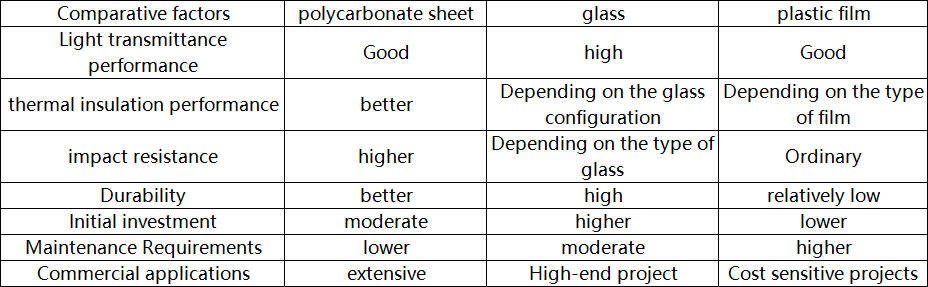
5. Consider Lifecycle Cost Instead of Material Price Alone
For commercial agricultural investors, covering material selection should not be based solely on purchase price. The more important consideration is the total lifecycle cost, including installation, energy consumption, maintenance, replacement, and potential impact on crop productivity.
For example, a lower-cost material may result in higher long-term expenses if it requires frequent replacement or leads to greater energy consumption. A higher-performance material may require greater initial investment but provide better long-term value by reducing maintenance and energy costs.
6. Select the Covering Solution Based on Project Requirements
The goal of commercial greenhouse roof selection is not to choose the most expensive material, but to develop a solution that matches the actual project requirements. Climate, crop type, greenhouse scale, investment budget, and automation level should all be considered during the design stage.
Zheyang Agriculture provides tailored greenhouse solutions based on specific project requirements. Polycarbonate panels, glass, or plastic film can be selected according to climate and cultivation needs, while the covering system can be integrated with the main structure, ventilation, shading, irrigation, and climate control systems.
Proper material selection at the early stage helps meet crop production requirements while controlling construction costs, energy consumption, and long-term maintenance expenses, providing a more stable foundation for commercial greenhouse investment.
Chapter 3: How Can Polycarbonate Roof Solutions Be Optimized?
1. How to Select the Right Polycarbonate Panel Structure?
Polycarbonate panels are available in different internal structures, with common options including twin-wall and multi-wall panels. These structures affect insulation, weight, light transmission, and overall cost.
For general commercial cultivation projects in relatively moderate climates, twin-wall panels can provide a practical balance between construction cost and basic insulation. For colder climates or year-round production projects, multi-wall panels may be considered for improved thermal performance.
Therefore, a more complex panel structure is not necessarily better. The key is selecting a structure that matches the actual project requirements.
2. How to Determine the Appropriate Panel Thickness?
Panel thickness should be determined according to the greenhouse structure and local environmental conditions. Wind loads, snow loads, temperature variations, greenhouse span, and installation methods can all influence panel specifications.
If the panel specification is insufficient, it may not meet the structural and operational requirements of the project. On the other hand, unnecessarily high specifications can increase material costs. Therefore, commercial greenhouse projects should determine covering material specifications together with the structural design rather than selecting panels separately after the main structure has been completed.
Zheyang Agriculture can develop polycarbonate roof solutions based on local climate, greenhouse scale, and structural design to ensure proper compatibility between the panels and the main structure.
3. How to Balance Light Transmission and Thermal Insulation?
For commercial agricultural projects, light transmission and thermal insulation should be considered together. Crops require sufficient light for photosynthesis, while greenhouse operators also need to minimize heat loss during colder periods. Therefore, roof solutions should be balanced according to crop type and local climate.
In hot climates, natural lighting should be coordinated with shading and ventilation to prevent excessive heat accumulation. In cold climates, greater attention should be given to panel insulation, sealing, and heating systems to reduce heat loss.
For year-round production projects, the roof system should be designed with seasonal changes in mind and properly integrated with the greenhouse climate control system.
4. How to Optimize Roof Sealing and Installation?
Although polycarbonate panels offer good overall performance, the actual performance of a roof system also depends on installation quality. Panel connections, fixing methods, sealing, and drainage design can all affect long-term greenhouse operation.
A properly designed installation system can help reduce water leakage, dust infiltration, and unnecessary heat exchange while lowering future maintenance requirements. For commercial greenhouses, the roof should also be coordinated with vents, shading equipment, and drainage systems to avoid installation conflicts.
Planning the panels and installation system together at the design stage can improve construction efficiency and reduce future maintenance and modification costs.
5. Optimize the Polycarbonate Roof Solution According to Project Requirements
The goal of a polycarbonate roof solution is not to select the highest-specification materials, but to create a covering system that matches the project requirements. Local climate, crop type, greenhouse scale, investment budget, and production goals should all be considered during the design process.
Zheyang Agriculture provides tailored commercial greenhouse solutions, integrating the greenhouse structure, polycarbonate panels, and supporting systems according to specific customer requirements. By selecting suitable panel structures and thicknesses and coordinating them with ventilation, shading, drainage, and climate control systems, unnecessary construction and operating costs can be controlled while meeting greenhouse performance requirements.
For commercial investors, the ultimate goal of roof optimization is to find the right balance between light transmission, thermal insulation, durability, energy efficiency, and long-term investment costs.
Chapter 4: Zheyang Agriculture Commercial Polycarbonate Greenhouse Roof Solutions
1. Design the Polycarbonate Greenhouse Structure Around Project Requirements
Commercial agricultural projects have different structural requirements. Zheyang Agriculture evaluates local wind, snow, temperature conditions, and greenhouse scale when planning the main structure and roof system. Structural spans, column layouts, roof design, and panel installation methods need to be coordinated to ensure a stable connection between the covering system and the main structure.
For large commercial greenhouses, equipment installation, personnel access, internal space utilization, and future maintenance should also be considered in advance to reduce modifications during construction and improve project efficiency.
2. Select Polycarbonate Panels According to Climate Conditions
The structure and thickness of polycarbonate panels affect light transmission, insulation, and durability. Zheyang Agriculture does not apply a single panel specification to every project. Instead, panels are selected according to local conditions and actual project requirements.
For projects in moderate climates with a stronger focus on investment efficiency, suitable hollow polycarbonate panels can provide a practical solution. For cold climates or year-round production, multi-wall structures with improved insulation can be considered. Panel specifications and installation methods should also be determined according to local wind and snow conditions.
3. Integrate the Roof with Ventilation and Shading Systems
An efficient commercial greenhouse roof should work together with the climate control system. In hot climates, roof vents, side ventilation, and shading can help reduce internal heat loads. In cold climates, appropriate panel structures and sealing can help minimize heat loss.
Zheyang Agriculture integrates roof covering, ventilation, and shading systems according to local climate and crop requirements. Proper coordination between systems can reduce unnecessary equipment operation and improve environmental stability inside the greenhouse.
4. Integrate the Structure with Supporting Systems
A commercial greenhouse is not a single product but an integrated system. In addition to the main structure and polycarbonate roof, irrigation, fertigation, cooling, heating, shading, and intelligent climate control systems can be configured according to project requirements.
Zheyang Agriculture develops solutions based on overall project needs to ensure compatibility in spatial layout, equipment installation, and system operation. For projects requiring automated management, environmental sensors and control systems can also be integrated to adjust equipment according to temperature, humidity, light, and other conditions.
5. Provide Tailored Support from Design to Manufacturing
Zheyang Agriculture focuses on providing tailored greenhouse design and manufacturing services for commercial agricultural projects. Compared with standardized greenhouse products, tailored solutions allow the structure, roof covering, and supporting systems to be adjusted according to actual project conditions.
From initial design and material selection to structural manufacturing and system configuration, each stage is developed around the specific project requirements. This approach improves solution compatibility while helping customers avoid unnecessary material and equipment investment.
6. Build Long-Term Value into Commercial Greenhouse Roof Solutions
The value of a commercial greenhouse roof is not limited to appearance or basic functionality after construction. Long-term stability, energy efficiency, and maintenance costs are equally important. Therefore, Zheyang Agriculture considers both initial construction costs and long-term operational requirements during the solution design process.
By properly integrating polycarbonate panels, the main structure, ventilation, shading, drainage, and climate control systems, Zheyang Agriculture develops suitable roof covering solutions for different regions and crops. The goal is not to provide the highest-specification product, but to deliver a commercial greenhouse solution that matches project requirements and provides long-term operational value.
Chapter 5: From Construction to Operation: How to Ensure Long-Term Returns from a Glass Greenhouse Project?
1. Control Project Quality During Construction
The main structure, glass covering system, and supporting equipment directly affect greenhouse performance. During construction, the structural design should be suitable for local climate conditions, while material quality and installation standards should be properly controlled. Commercial projects should also pay close attention to sealing, drainage, ventilation, and equipment installation to reduce future maintenance and modification requirements.
For investors, selecting a reliable design and manufacturing supplier at the beginning can reduce the risk of structural changes, material replacement, and equipment incompatibility, creating a stable foundation for long-term operation.
2. Configure Climate Control Systems Properly
Glass greenhouses provide excellent natural light, but commercial production still requires ventilation, shading, cooling, heating, irrigation, and other systems according to local climate and crop requirements. More equipment does not necessarily mean a better solution; system configuration should match actual production objectives.
For example, hot climates may require stronger ventilation, shading, and cooling systems, while cold climates may place greater emphasis on insulation and heating. Proper system configuration helps maintain a stable growing environment while avoiding unnecessary investment caused by overconfiguration.
3. Reduce Operating Costs Through Energy Management
Energy costs are an important consideration in the long-term operation of commercial greenhouses. Temperature control, ventilation, cooling, and heating equipment can all contribute significantly to operating expenses. Therefore, system parameters should be adjusted according to seasons, weather conditions, and crop growth stages.
An automated climate control system can monitor temperature, humidity, light, and other conditions in real time and adjust equipment accordingly. Reducing unnecessary equipment operation can lower energy consumption while improving overall greenhouse efficiency.
4. Establish a Long-Term Maintenance and Equipment Management System
Construction is not the end of greenhouse project management. During long-term operation, the glass covering, main structure, ventilation equipment, shading systems, irrigation systems, and climate control equipment should be inspected regularly.
For commercial projects, preventive maintenance is generally more effective than waiting for equipment failures. Establishing maintenance schedules and keeping operational records can help identify potential problems early, reduce disruptions to production, and extend the service life of the greenhouse and its supporting equipment.
5. Continuously Optimize Operations Based on Production Data
Long-term returns depend not only on greenhouse hardware but also on operational efficiency. Commercial greenhouses can record temperature, humidity, light levels, water and fertilizer consumption, and crop yields to evaluate how environmental conditions affect production.
By continuously optimizing irrigation, ventilation, shading, and temperature control parameters, resource efficiency can be improved over time. For large-scale agricultural projects, data-driven management can also identify potential issues in energy consumption and production costs, providing useful information for future expansion and system upgrades.
6. Evaluate Project Returns from a Lifecycle Perspective
When evaluating a glass greenhouse project, investors should consider more than the initial construction price. Energy costs, labor costs, maintenance expenses, equipment upgrades, and expected production returns should all be included. A solution with a lower initial investment may not deliver better returns if its long-term energy and maintenance costs are significantly higher.
Zheyang Agriculture provides tailored glass greenhouse solutions based on project location, climate conditions, crop type, cultivation scale, and investment objectives. By integrating structural design, glass covering, climate control, and supporting systems, Zheyang Agriculture helps customers achieve a practical balance between construction costs, operational efficiency, and long-term value.
Chapter 6: How to Balance Construction Costs, Energy Efficiency, and Returns?
1. Control Construction Costs Based on Project Requirements
Cost control does not mean reducing the overall quality of the greenhouse. Instead, unnecessary investment should be avoided. Greenhouse size, structural design, polycarbonate panel specifications, and automation systems should all be selected according to actual production requirements.
For small and medium-sized commercial projects, basic ventilation, shading, and irrigation systems may be sufficient. Larger or year-round operations may require intelligent climate control and higher levels of automation. Proper planning at the early stage can reduce future modification costs and improve capital efficiency.
2. Reduce Long-Term Energy Costs Through Efficient Systems
Greenhouse operating costs are closely related to energy consumption. Proper polycarbonate panel selection combined with ventilation, shading, insulation, and cooling systems can improve environmental control efficiency.
In hot climates, natural ventilation and shading can reduce heat loads before mechanical cooling is activated when necessary. In cold climates, insulation and heating systems can help minimize heat loss. Coordinating these systems allows the greenhouse to maintain suitable growing conditions while reducing unnecessary energy consumption.
3. Evaluate Greenhouse Investment Based on Long-Term Returns
The return on a commercial greenhouse investment depends not only on construction costs but also on crop yield, production cycles, energy expenses, labor costs, and equipment maintenance. Greenhouse solutions should therefore be evaluated from a lifecycle perspective.
A greenhouse with a lower initial price but higher energy consumption may not deliver lower overall costs. Likewise, excessive specifications can extend the investment payback period. The right solution should meet production objectives while keeping both initial investment and long-term operating costs within a reasonable range.
4. Achieve Investment Balance Through Tailored Solutions
The optimal investment strategy varies from project to project. Zheyang Agriculture develops tailored solutions based on project location, climate conditions, greenhouse scale, crop type, investment budget, and production objectives, rather than applying a standardized configuration.
From the greenhouse structure and polycarbonate panels to ventilation, shading, irrigation, cooling, and intelligent climate control systems, Zheyang Agriculture plans each solution according to actual requirements. By properly matching different components, the solution can meet production needs while avoiding unnecessary costs and supporting long-term operational goals.
5. Balance Cost and Returns Instead of Simply Pursuing Low Prices
For commercial agricultural investors, the right greenhouse solution should focus on the long-term value generated by each investment. Construction costs determine the initial investment threshold, energy efficiency affects daily operating expenses, while production efficiency and system reliability influence long-term returns.
Therefore, when selecting a commercial polycarbonate greenhouse, investors should consider initial investment, energy consumption, maintenance costs, automation level, and future upgrade potential together. Through proper design and system configuration, projects can achieve a more practical balance between construction costs, energy efficiency, and long-term returns.


