



Purchasing Polycarbonate Greenhouse Kits: How to Choose Between Standard Kits, Customized Solutions, and Project Delivery Models?
Chapter 1: What Should You Consider Before Purchasing a Polycarbonate Greenhouse Kit?
Before purchasing a polycarbonate greenhouse kit, clearly defining project requirements is essential for controlling costs, ensuring greenhouse performance, and keeping the project on schedule. For commercial farming projects, a greenhouse is not simply a standardized product. Different locations, crops, and production scales require different structural designs, covering materials, and supporting systems. Therefore, buyers should evaluate the overall project requirements rather than focusing only on the purchase price.
First, it is important to consider the project location and local climate conditions. Temperature, wind, rainfall, and snow loads can all affect greenhouse structural design and material selection. Choosing an appropriate structural strength and covering solution based on local conditions can improve greenhouse stability and reduce potential maintenance risks.
The greenhouse size, dimensions, and cultivation scale should also be determined in advance. Small-scale farming projects can consider standardized polycarbonate greenhouse kits, while medium and large commercial projects may require customized designs based on available land and production plans. Proper space planning can improve land utilization while allowing for future expansion and system upgrades.
Crop types and production objectives are another key consideration. Vegetables, flowers, nurseries, and hydroponic farming have different requirements for light, temperature, humidity, and ventilation. The greenhouse structure and functional configuration should therefore be selected according to specific crop requirements.
Buyers should also determine the polycarbonate panel specifications and supporting systems in advance. Panel type, thickness, and installation method can affect light transmission, insulation, and durability. Depending on project requirements, ventilation, shading, irrigation, cooling, and climate control systems can also be integrated to improve commercial production efficiency.
Finally, buyers need to consider the budget, transportation, and installation conditions. In addition to the greenhouse itself, packaging, shipping, installation, and future maintenance costs should be included in the overall project budget. For overseas projects or locations with complex installation conditions, it is also important to clarify the supplier's delivery scope, technical documentation, and installation support.
Therefore, the key to purchasing a polycarbonate greenhouse kit is not simply choosing the lowest-priced option, but selecting the right structure, materials, and configuration based on actual project requirements. For complex commercial farming projects, working with a professional greenhouse design and manufacturing supplier can provide a more suitable customized solution and create a stronger foundation for long-term agricultural production and investment returns.

Chapter 2: Standard Polycarbonate Greenhouse Kits vs. Customized Solutions: Which Is Better?
1. Standard Polycarbonate Greenhouse Kits: Suitable for Simple and Clearly Defined Projects
Standard polycarbonate greenhouse kits generally use relatively standardized structures and specifications. They offer a simpler purchasing process and usually require less time for project planning. For small commercial farms, nursery projects, community agriculture, and projects with clearly defined greenhouse dimensions and functions, standard kits can provide an efficient purchasing solution.
One major advantage of a standard kit is its clear configuration. Buyers can select products according to available sizes and functions. If local installation resources are available, customers can also arrange installation themselves or work with a local installation team, providing greater flexibility in controlling project costs.
However, standard kits have certain limitations in terms of structure and configuration. If a project requires special greenhouse dimensions, structural strength, panel specifications, or automation systems, a standard product may not fully meet the actual requirements.
2. Customized Polycarbonate Greenhouses: Designed for Medium and Large Commercial Projects
For medium and large commercial farming projects, customized greenhouse solutions generally provide greater flexibility. The supplier can design the greenhouse according to the project location, climate conditions, land dimensions, crop types, and production objectives.
A customized solution can adjust not only the greenhouse size and layout but also integrate ventilation, shading, irrigation, cooling, and smart climate control systems according to project requirements. For agricultural businesses planning long-term commercial production, this tailored approach can improve land utilization and production efficiency while allowing room for future expansion and system upgrades.
3. How Should You Choose?
If the project is relatively small, has simple and clearly defined requirements, and prioritizes fast purchasing and installation, a standard polycarbonate greenhouse kit is usually a suitable choice.
For medium or large commercial farming projects, or projects with specific requirements for greenhouse dimensions, structural strength, climate adaptability, or smart equipment, a customized greenhouse solution is generally more appropriate.
As a professional greenhouse design and manufacturing supplier in China, Zheyang Agriculture provides customized polycarbonate greenhouse solutions based on project location, climate conditions, crop types, greenhouse scale, and budget requirements. By coordinating structural design and supporting systems, the company helps customers develop greenhouse solutions that better match their actual production needs.
In short, standard kits are suitable for projects that prioritize convenient purchasing and rapid deployment, while customized solutions are better suited to commercial farming projects that focus on long-term operational efficiency and project-specific requirements. Choosing the right procurement model is more important than simply choosing the highest configuration or the lowest price.
Chapter 3: How to Choose the Right Greenhouse Delivery Model Based on Project Scale?
1. Standard Kit Supply: Suitable for Small and Simple Projects
For small-scale agricultural projects with clearly defined structural requirements, a standard polycarbonate greenhouse kit can be a practical choice. The supplier provides the main greenhouse structure, polycarbonate panels, and related components according to standard specifications, while the customer can arrange local installation.
This model generally offers a simpler purchasing process and shorter preparation time. Customers can also use local construction resources to manage installation costs more flexibly. It is therefore suitable for small commercial farms, nursery projects, and buyers with local installation capabilities.
2. Customized Design + Manufacturing Delivery: Suitable for Medium and Large Projects
When a greenhouse project is larger or requires specific structural dimensions, material specifications, or functional configurations, customized design and manufacturing delivery is generally more suitable.Under this model, the supplier first develops a greenhouse solution based on the project location, climate conditions, land dimensions, and cultivation requirements. After the design is confirmed, the greenhouse and related components are manufactured and delivered to the project location.
Compared with standard kits, this model provides greater flexibility and can better match specific project requirements. It is particularly suitable for commercial vegetable farms, flower cultivation projects, and medium-to-large agricultural facilities.
3. Complete Project Solution: Suitable for Large Agricultural Projects
For large agricultural parks, commercial cultivation bases, and overseas agricultural engineering projects, purchasing only the greenhouse structure may not be sufficient. These projects often require a more comprehensive complete project delivery model.
The supplier can provide greenhouse design, manufacturing, supporting equipment configuration, installation guidance, and technical project support according to specific requirements. Ventilation, shading, irrigation, cooling, and climate control systems can also be integrated into the overall solution when required.
This model reduces the need for customers to coordinate with multiple suppliers and is particularly suitable for large commercial farming projects that require one-stop project support.
4. Zheyang Agriculture: Flexible Delivery Based on Project Requirements
As a professional greenhouse design and manufacturing supplier in China, Zheyang Agriculture provides customized greenhouse solutions based on project scale, cultivation requirements, and delivery expectations. From standardized products to customized design and manufacturing, as well as supporting system planning, the company can adjust its solution according to specific project conditions.Therefore, a more complex delivery model is not necessarily better. Small projects can prioritize standard greenhouse kits, medium and large projects can consider customized design and manufacturing, while large agricultural engineering projects may benefit from a complete project solution.
Choosing a delivery model that matches the project scale and actual requirements can help commercial farming businesses control costs, reduce project risks, and establish a stronger foundation for long-term operations.
Chapter 4: Zheyang Agriculture Polycarbonate Greenhouse Solutions: From Standard Kits to Customized Projects
1. Polycarbonate Greenhouses: Combining Performance with Commercial Applications
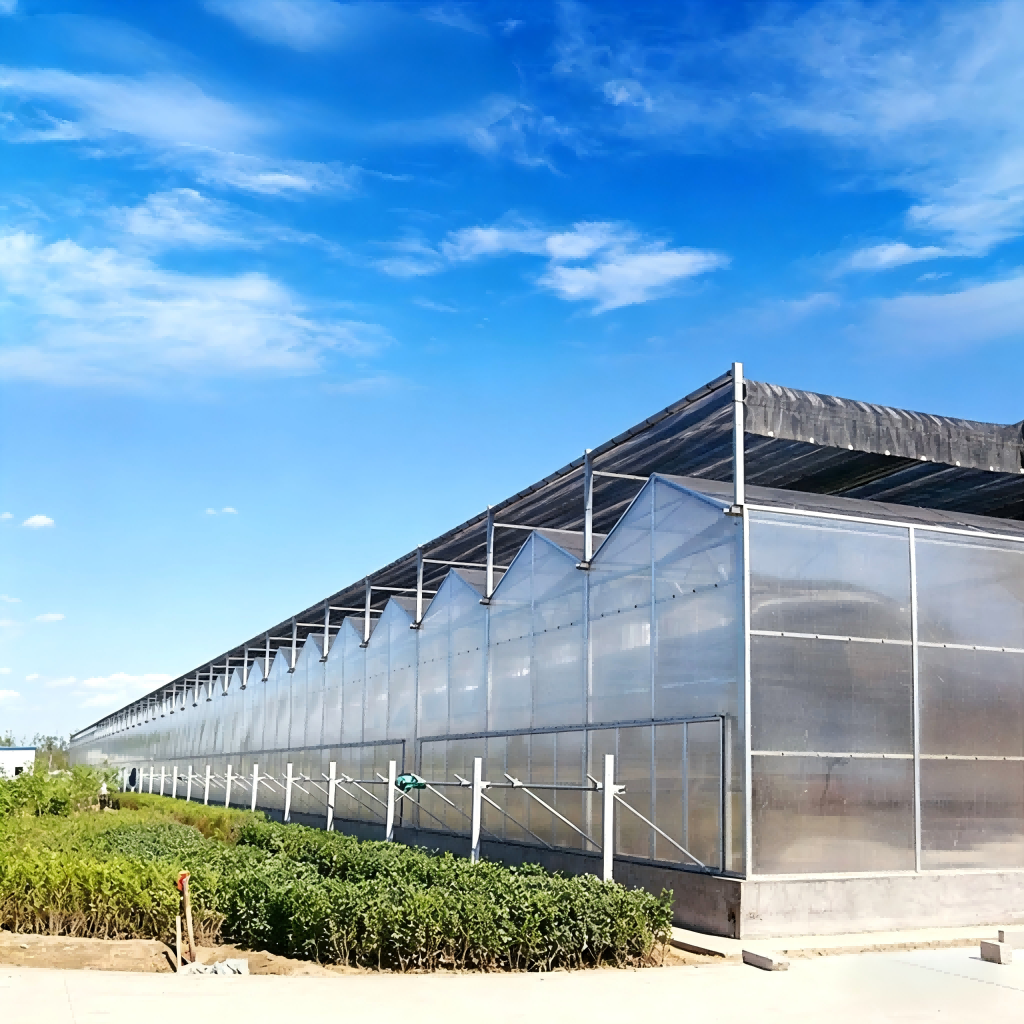
Zheyang Agriculture provides polycarbonate greenhouse systems mainly constructed with polycarbonate panels and steel structures. The greenhouse structure and covering solution can be customized according to specific project requirements. Polycarbonate materials offer good insulation and impact resistance while supporting the lighting and environmental control requirements of various commercial cultivation projects.
These greenhouses are suitable for vegetable cultivation, flower production, nurseries, hydroponic farming, and commercial agricultural bases. Ventilation, shading, irrigation, cooling, and other systems can be integrated according to project requirements to improve environmental control and provide a reliable foundation for commercial production.
2. Standard Greenhouse Kits: Suitable for Fast Deployment
For customers with relatively small greenhouse projects, clearly defined requirements, and a need for efficient procurement, a standard polycarbonate greenhouse kit can be a practical solution.
Zheyang Agriculture can provide the greenhouse structure, polycarbonate panels, and related components according to project requirements. Standardized products can simplify the initial purchasing process and are suitable for small commercial farms, nursery projects, and customers with local installation capabilities.
For buyers, the advantage of a standard kit is not only its relatively simple procurement process but also the flexibility to configure the greenhouse according to project budgets and actual requirements.
3. Customized Greenhouses: Designed for Specific Project Requirements
When a project is larger or requires specific greenhouse dimensions, structural strength, panel specifications, or equipment configurations, a customized solution can provide greater flexibility.Zheyang Agriculture can develop solutions based on the project location, local climate, land conditions, crop types, greenhouse size, and budget. The greenhouse structure and functional configuration can be adjusted according to actual production requirements, while space can be reserved for future expansion and smart system upgrades.
For commercial agricultural investors, customized design avoids simply applying standard specifications to every project. Instead, the greenhouse can be developed according to actual site conditions, helping improve land utilization and long-term operational efficiency.
4. Supporting Systems and Integrated Solutions
A modern commercial greenhouse requires not only a reliable structure but also appropriate environmental control and agricultural systems. Depending on project requirements, Zheyang Agriculture can provide configuration planning for ventilation, shading, irrigation, cooling, and environmental control systems.Considering the greenhouse structure and supporting equipment as an integrated system can reduce communication between multiple suppliers and improve compatibility between different components, providing customers with a more reliable foundation for future operations.Whether purchasing a standard polycarbonate greenhouse kit or developing a medium-to-large commercial farming project, Zheyang Agriculture can provide appropriate design and manufacturing solutions based on specific customer requirements.
From standard kits to customized projects, and from individual greenhouse structures to integrated system configurations, Zheyang Agriculture focuses on project-specific needs to provide flexible and professional polycarbonate greenhouse solutions for customers worldwide.
Chapter 5: How to Control Costs and Project Risks When Purchasing Polycarbonate Greenhouse Kits?
For commercial farming projects, purchasing a polycarbonate greenhouse kit should involve more than simply comparing supplier quotations. Buyers need to evaluate total project costs, equipment configuration, transportation, installation, and long-term operation. A lower purchase price does not necessarily mean a lower overall project cost. Careful planning and supplier evaluation are essential for controlling investment risks. Commercial greenhouse selection should consider local climate, crop types, project scale, energy consumption, and future expansion requirements.
First, buyers should clearly define the greenhouse structure, polycarbonate panel specifications, ventilation, shading, irrigation, cooling, and other supporting systems. This helps avoid major modifications after procurement and prevents unnecessary additional costs. For projects requiring automated management, environmental monitoring and smart control systems should also be planned in advance to ensure compatibility between the greenhouse structure and future equipment.
Second, buyers should evaluate the total project cost rather than focusing only on the initial purchase price. In addition to the greenhouse structure and covering materials, the budget should include packaging, transportation, installation, equipment configuration, maintenance, and potential future upgrades. Clearly defining product specifications, component lists, and delivery responsibilities can significantly reduce unexpected expenses and communication risks during project implementation.
Supplier capabilities are another important consideration. A professional greenhouse manufacturer can develop suitable structural and functional solutions according to local climate conditions, crop requirements, project scale, and budget. As a professional greenhouse design and manufacturing supplier in China, Zheyang Agriculture provides customized polycarbonate greenhouse solutions and can support structural design, manufacturing, and greenhouse system configuration according to specific project requirements.
From a long-term operational perspective, a well-designed greenhouse should also consider energy efficiency, maintenance costs, and future expansion. A properly configured polycarbonate greenhouse should not only meet current cultivation requirements but also allow future automation upgrades and production expansion.
Therefore, when purchasing a polycarbonate greenhouse kit, businesses should not simply pursue the lowest quotation. Instead, they should focus on appropriate configuration, clear delivery scope, supplier expertise, and controllable long-term operating costs. Through professional planning and customized design, businesses can reduce procurement and implementation risks while achieving more stable returns from their commercial farming investment.
Chapter 6: How to Choose the Right Polycarbonate Greenhouse Supplier?
For commercial farming projects, choosing a polycarbonate greenhouse supplier should involve more than simply comparing product prices. A greenhouse is a long-term agricultural investment, and its design, manufacturing quality, and project support can directly affect production efficiency and operating costs. Therefore, evaluating suppliers carefully before procurement is essential for reducing project risks and protecting long-term investment returns.
First, buyers should focus on the supplier’s professional design capabilities. Climate conditions, crop types, and cultivation scales vary from one project to another, and greenhouse structures need to be adapted accordingly. A professional supplier should be able to consider local wind conditions, rainfall, temperature, and other factors when designing the greenhouse structure, polycarbonate panels, ventilation systems, shading systems, and other components, rather than simply providing a standard product.
Second, buyers should evaluate the supplier’s customization and manufacturing capabilities. For medium- and large-scale commercial farming projects, standard greenhouse kits may not fully meet actual requirements. The supplier should be capable of customizing the greenhouse according to dimensions, crop types, equipment configurations, and budget. Stable manufacturing capabilities are also an important indicator of reliable project delivery.
Another important consideration is the supplier’s greenhouse system integration and technical support. Modern polycarbonate greenhouses often need to work with ventilation, shading, irrigation, cooling, and environmental control systems. A supplier capable of providing appropriate system configurations and technical support can reduce the communication costs associated with working with multiple suppliers and improve overall project coordination.
In addition, buyers should pay close attention to product specifications and delivery scope. Before signing a purchase contract, the greenhouse structure, polycarbonate panels, accessories, equipment, packaging, transportation, installation guidance, and other responsibilities should be clearly defined. This can help prevent unclear configurations and unexpected additional costs during project implementation.
As a professional greenhouse design and manufacturing supplier in China, Zheyang Agriculture provides customized polycarbonate greenhouse solutions based on project location, climate conditions, crop requirements, project scale, and budget. The company can support structural design, greenhouse manufacturing, and supporting system configuration according to specific commercial farming requirements.
Therefore, when selecting a polycarbonate greenhouse supplier, businesses should evaluate design capabilities, manufacturing experience, customization capabilities, system integration, delivery scope, and technical support rather than simply choosing the lowest quotation. Working with a qualified and experienced supplier can turn greenhouse procurement from a simple product purchase into a long-term and value-oriented agricultural project partnership.
Chapter 7: Conclusion: Standard Kit, Customized Solution, or Complete Project Delivery?
When purchasing a polycarbonate greenhouse kit, there is no single solution that fits every project. For commercial agricultural businesses, the key is not simply to choose the lowest-priced or most highly configured option, but to select the procurement and delivery model that best matches the project scale, crop requirements, budget, local installation conditions, and automation needs.
For small cultivation projects, nursery operations, or projects with clearly defined requirements, a standard polycarbonate greenhouse kit is often an efficient choice. Standardized products can simplify the purchasing process, shorten the initial planning period, and make local installation easier. This model is particularly suitable for customers with their own local construction or installation teams.
For medium- and large-scale commercial farming projects, especially those involving specific climate conditions, structural requirements, or functional configurations, a customized greenhouse solution can provide greater value. By designing the greenhouse according to project area, local wind and snow loads, crop types, ventilation, shading, irrigation, and climate-control requirements, the structure and functions can be better aligned with actual production needs. Compared with simply purchasing a standard kit, customization can provide greater flexibility in long-term operation and leave room for future expansion and smart system upgrades.
For large agricultural parks, commercial cultivation bases, and overseas agricultural engineering projects, a complete project delivery model may be more appropriate. This approach can coordinate greenhouse design, manufacturing, equipment configuration, transportation, and installation guidance, helping reduce communication costs and project management risks caused by working with multiple suppliers.
The three models can therefore be summarized simply: standard kits are suitable for small, simple, and fast-purchase projects; customized solutions are suitable for medium- and large-scale commercial farming projects; and complete project delivery is better suited to large agricultural engineering projects requiring integrated services.
As a professional greenhouse design and manufacturing supplier in China, Zheyang Agriculture provides customized greenhouse design and manufacturing services based on specific customer requirements. Solutions can be developed according to project location, climate conditions, crop types, greenhouse size, structural requirements, covering materials, automation configuration, and budget.
For businesses planning long-term commercial cultivation, the value of working with a professional supplier goes beyond purchasing a greenhouse product. It also means obtaining project-specific design, manufacturing capabilities, and technical support. Ultimately, the right procurement model should be based on actual project requirements and long-term investment value, rather than simply comparing product prices.