



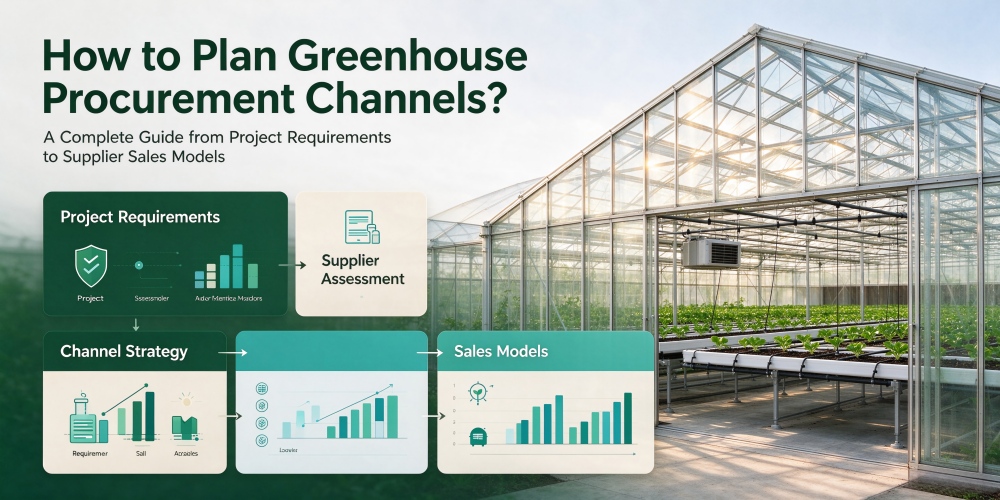
How to Plan Greenhouse Procurement Channels? A Complete Guide from Project Requirements to Supplier Sales Models
Chapter 1: What Project Requirements Should Be Defined Before Purchasing a Greenhouse?
Before purchasing a greenhouse, buyers should first define their project requirements instead of immediately comparing suppliers and prices. Project location, climate, crop type, greenhouse scale, budget, and production goals all influence the selection of greenhouse structures, covering materials, and supporting systems. The clearer the requirements, the more effectively buyers can select procurement channels and suppliers.
First, buyers should determine the project location and local climate, including temperature, rainfall, wind, and snow conditions. Different climates create different requirements for structural stability, ventilation, insulation, and drainage. Buyers should also define the crop type and production goals. Vegetables, flowers, seedlings, and high-value crops can have different requirements for light, temperature, humidity, and environmental control.
Greenhouse area, future expansion plans, and budget should also be clarified. Small commercial projects may prioritize initial investment and construction efficiency, while large agricultural projects may require greater attention to large-scale production, automation, and long-term operating costs. Buyers should also define their requirements for glass, polycarbonate, or film coverings, as well as irrigation, fertigation, shading, cooling, and smart control systems.
With these core requirements clearly defined, buyers can select more suitable procurement channels and provide accurate information when requesting quotations, reducing repeated design changes and unexpected costs during the procurement process.
Chapter 2: What Are the Main Greenhouse Procurement Channels and Their Characteristics?
Once project requirements are defined, the next step is selecting the right greenhouse procurement channel. Different channels vary in product sourcing, pricing, technical support, communication efficiency, and project services. For commercial agricultural projects, buyers should select a channel based on project scale, technical complexity, and budget rather than price alone.
Direct purchasing from greenhouse manufacturers is a common option. Buyers can communicate directly with the manufacturer regarding structural design, covering materials, and supporting systems, reducing intermediary links and making it easier to adjust solutions and confirm technical details. This approach is particularly suitable for large commercial greenhouse projects requiring tailored solutions.
Traders and distributors usually offer access to a broad range of products and can help buyers compare different options quickly. However, intermediary processes may affect pricing and technical communication. This channel can be convenient for standardized products or projects with relatively simple technical requirements.
Engineering companies and agricultural project integrators are more suitable for large-scale integrated agricultural projects. Their advantage is the ability to coordinate greenhouses, equipment, and other agricultural infrastructure. However, procurement may involve more complex responsibilities, so buyers should clearly confirm product sources, project scope, and technical responsibilities.
B2B platforms and online channels allow buyers to quickly identify overseas suppliers, request multiple quotations, and conduct preliminary screening. However, supplier capabilities can vary significantly, making it necessary to verify manufacturing capabilities, technical solutions, and delivery experience. Local suppliers can offer advantages in on-site communication, installation, and after-sales service, although product options and costs may be limited by location.
There is therefore no single procurement channel that is best for every project. For commercial greenhouses requiring structural design, tailored manufacturing, and integrated system configuration, working directly with a professional supplier that has both design and manufacturing capabilities can often improve communication efficiency and project fit.
Chapter 3: How Can Buyers Evaluate a Greenhouse Supplier’s Sales Model?
After selecting a procurement channel, buyers should also understand the supplier’s sales model. The same greenhouse product can differ significantly in price, technical communication, solution flexibility, and after-sales support depending on how it is sold. Therefore, product quantity or quotation alone cannot fully indicate a supplier’s actual capabilities.
The first model is direct sales from the manufacturer, where buyers work directly with the greenhouse factory. Such suppliers can usually communicate directly about structural design, materials, and equipment configurations, reducing intermediary links and allowing greater flexibility in dimensions, covering materials, and supporting systems. This model is often suitable for commercial projects requiring tailored greenhouse solutions.
The second model is manufacturing combined with project services. In this model, the supplier is responsible not only for greenhouse production but also for requirement analysis, solution design, technical confirmation, manufacturing, and delivery support. This approach can be particularly valuable for large commercial agricultural projects because it reduces communication and coordination between multiple parties.
Another common model is distribution or agency sales. Distributors may provide broader product access and wider market coverage, but some technical issues may need to be confirmed with the original manufacturer. Buyers should therefore verify the actual manufacturer, product source, and after-sales responsibilities.
Buyers should also distinguish between standardized product sales and project-based sales. Standardized sales usually focus on fixed specifications and configurations and can work well for relatively simple projects. Project-based sales adjust the solution according to location, climate, crop type, scale, and budget, making them more suitable for commercial agricultural projects with specific requirements.
When evaluating a supplier’s sales model, buyers should therefore ask: Who handles the design? Who manufactures the greenhouse? Who provides technical support? And who is responsible for delivery? Understanding the complete sales and service chain helps buyers determine whether the supplier has the capabilities required for their specific project.
Chapter 4: What Greenhouse Products and Procurement Solutions Does Zheyang Agriculture Provide?
As a professional greenhouse design and manufacturing supplier in China, Zheyang Agriculture does not focus only on fixed-standard greenhouse models. Instead, it develops suitable greenhouse products and procurement solutions based on the project location, climate, crop type, project scale, budget, and production goals. Through direct communication with buyers, greenhouse structures, covering materials, and supporting systems can be better matched to project requirements.
Zheyang Agriculture provides Venlo, multi-span, glass, polycarbonate, film, tunnel, and Gothic greenhouse solutions for large agricultural parks, commercial farms, vegetable production, high-value crops, and projects of different scales. Each greenhouse type can be configured according to local environmental conditions and growing requirements.