



How Can Film Greenhouses Meet the Needs of Large-Scale Agricultural Production?
Chapter 1: Why Are Large-Scale Agricultural Projects Choosing Film Greenhouses?
As commercial agriculture becomes increasingly large-scale and specialized, large agricultural projects are focusing not only on production capacity but also on construction costs, land utilization, expansion flexibility, and long-term operating efficiency. For projects requiring extensive growing areas, film greenhouses are a practical option due to their flexible structures, diverse covering materials, and relatively controllable construction costs.
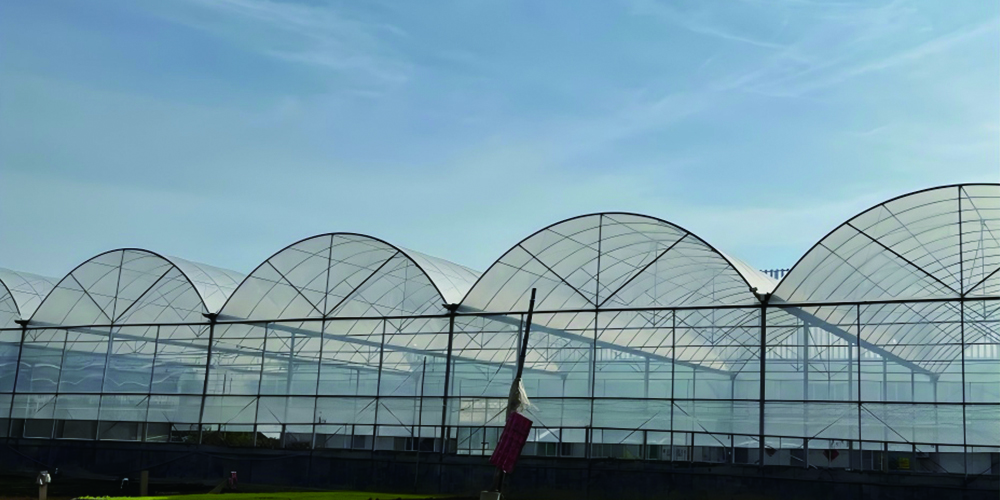
Film greenhouses can be designed with single-span, multi-span, or other suitable structures according to project scale and land conditions, while also allowing future expansion. With properly configured roll-up side ventilation, roof ventilation, shading, cooling, irrigation, and fertigation systems, film greenhouses can support commercial production of vegetables, seedlings, flowers, and certain fruit crops.
More importantly, a film greenhouse does not necessarily mean a low-specification solution. For large-scale agricultural projects, proper structural design and equipment configuration can help balance investment requirements with production needs. The key is not simply comparing prices, but selecting the right overall solution based on project scale, local climate, crop type, and production goals.

Chapter 2: What Are the Advantages of Film Greenhouses for Large-Scale Agriculture?
Film greenhouses are widely used in large-scale agricultural projects because of their flexible structures, diverse construction options, and wide range of covering materials. For commercial farms requiring extensive growing areas, a properly designed film greenhouse can provide a practical balance between infrastructure investment, growing capacity, and functional configuration.
First, film greenhouses can be designed as single-span, multi-span, or other structural configurations, allowing layouts to be adapted to available land and project scale. This makes them suitable for phased development and future expansion of large agricultural facilities.
Second, covering films can be selected according to local climate and crop requirements, including PE film, PO film, UV-resistant film, anti-drip film, and diffused-light film. Combined with roll-up side ventilation and roof ventilation, natural airflow can help regulate the greenhouse environment, while shading, cooling, heating, and irrigation systems can be added when required.
Therefore, the advantage of a film greenhouse is not simply its relatively controllable construction cost, but also the flexibility of its structure, covering materials, and supporting systems, making it adaptable to commercial agricultural projects with different scales and production goals.
Chapter 3: How Can Film Greenhouses Improve Large-Scale Farming Efficiency?
For large-scale agricultural projects, production efficiency depends not only on yield per unit area, but also on land utilization, environmental control, labor management, and resource allocation. A properly designed film greenhouse can improve the overall management efficiency of large growing operations through optimized structures and supporting systems.
First, multi-span film greenhouses can integrate multiple growing areas into continuous greenhouse spaces, making planting, ventilation, irrigation, and equipment management easier to organize. For large agricultural bases, an efficient greenhouse layout can simplify management across different production zones and facilitate future expansion.
Second, roll-up side ventilation, roof ventilation, shading, and cooling systems can be configured according to local climate and crop requirements to help regulate the greenhouse environment. Compared with relying entirely on manual operations, appropriate climate-control systems can reduce repetitive work and make daily management more controllable.
Film greenhouses can also integrate drip irrigation and fertigation systems to manage water and nutrients according to different crop growth stages. For large commercial growing projects, centralized and zone-based resource management can improve the efficiency of irrigation and fertigation operations.
Therefore, the key to improving large-scale farming efficiency is not a single piece of equipment, but the combination of efficient structure + climate control + water and nutrient management + zone-based operations, creating a production system that is easier to manage, expand, and operate over the long term.
Chapter 4: How Should Different Large-Scale Agricultural Projects Choose a Film Greenhouse Solution?
Large-scale agricultural projects differ significantly in crop type, climate, available land, and production goals. Therefore, film greenhouses should not rely on a one-size-fits-all configuration. The right solution should be selected based on project scale, crop type, local climate, growing method, and budget.
For large-scale vegetable production, multi-span film greenhouses can provide continuous layouts and be combined with roll-up side ventilation, roof ventilation, shading, drip irrigation, and fertigation systems to improve daily management efficiency. For nursery projects, greater attention should be given to temperature, humidity, shading, and irrigation control to create suitable conditions for seedling growth.
For flower or high-value crop projects, the film type and supporting systems can be selected according to specific light, temperature, and humidity requirements. In hot climates, greater attention should be given to ventilation and cooling, while colder regions may require insulating films and heating systems.
For large agricultural bases, future expansion and zone-based management should also be considered. Proper planning of greenhouse spans, growing areas, and equipment systems allows different production zones to be managed independently while leaving room for future expansion.
Therefore, buyers should not compare film greenhouses based only on price or area. The structure and equipment configuration should be determined according to actual production requirements. The right solution is one that matches the local climate, crop requirements, and long-term production goals.
Chapter 5: What Film Greenhouse Solutions Does Zheyang Agriculture Provide?
For large-scale agricultural projects, a film greenhouse is more than simply choosing a structure and covering material. The solution needs to be planned according to the project location, climate, crop type, growing scale, budget, and production goals. Zheyang Agriculture provides project-specific solutions covering greenhouse structure design and supporting systems to create a greenhouse system that fits the actual growing requirements.
1. Multiple Film Greenhouse Structures
Depending on land area and growing requirements, Zheyang Agriculture can provide single-span, multi-span, tunnel, Gothic, and other film greenhouse solutions. Multi-span structures can support efficient land utilization and zone management for large-scale projects, while single-span or other flexible structures can be considered for projects requiring phased development or easier expansion.
2. Film Options Based on Crop and Climate
Film performance directly affects light transmission, insulation, and environmental control. Zheyang Agriculture can recommend suitable PE, PO, UV-resistant, anti-drip, and diffused-light films according to local climate and crop requirements, helping balance light conditions, durability, and growing performance.
3. Ventilation, Shading, and Cooling Systems
According to local temperature and humidity conditions, film greenhouses can be equipped with roll-up side ventilation, roof ventilation, shading systems, and cooling systems. Combining these systems appropriately can improve airflow and temperature management, creating a more stable growing environment for vegetables, seedlings, flowers, and other crops.