



2026-11-13
Commercial gothic greenhouses enable high-yield cultivation in the face of extreme weather
As extreme weather becomes increasingly common, commercial cultivation requires more robust structures. Consequently, growers in the international agricultural sector are moving away from traditional, basic plastic-covered greenhouses in favor of specialized gothic greenhouse manufacturers—companies that integrate both design and structural fabrication. This type of greenhouse structure fills the market gap between simple plastic-covered hoop houses and high-end Venlo-style glass greenhouses, offering industrial-grade environmental control capabilities.
Unlike greenhouse traders who rely on outsourcing, Zheyang—as a professional gothic greenhouse manufacturer—operates its own modern production facility and maintains full control over every stage of the process:
- Precision CNC Machining: Equipped with automated high-power fiber laser tube cutters, laser sheet-cutting systems, and CNC mandrel tube benders, every connecting component is manufactured to precise mechanical tolerance standards.
- Hot-Dip Galvanizing: As commercial Gothic-style greenhouses are primarily designed for large-scale cultivation, all structural columns, arches, and tie beams undergo hot-dip galvanizing, ensuring a service life of 10–15 years.
- Prefabricated Bolted Assembly: All structural connections utilize factory-prefabricated clamps, pre-punched connection plates, and marine-grade stainless steel fasteners. This approach not only preserves the integrity of the galvanized coating but also enables rapid on-site assembly.
We have a track record of successful project deliveries across various countries and regions, and we can customize commercial gothic greenhouses to suit different operating environments.
Some users might ask: what distinguishes a commercial gothic greenhouses from other types of greenhouses?
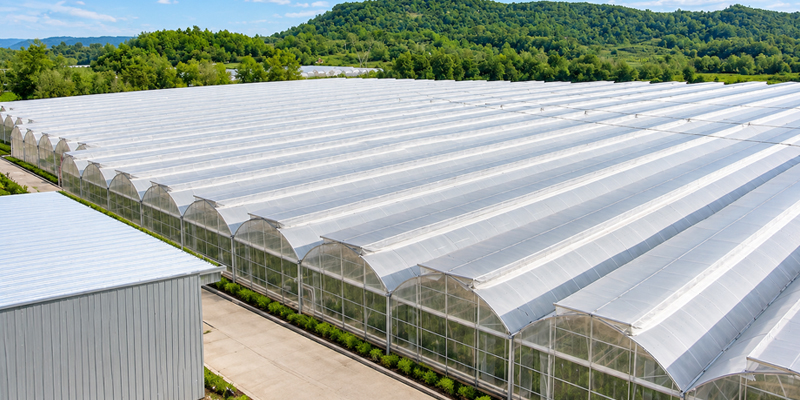
- Appearance: The Gothic-style greenhouse is distinguished by its pointed-arch structure, which can reach a peak height of 5.5 meters. This design allows accumulated snow to slide easily off the arched roof and into the surrounding gutters, effectively preventing snow buildup.
- Condensation Control: Unlike round-arched greenhouses, the Gothic structure features an internal slope exceeding 28° near the gutters. Leveraging the surface tension of water, condensation forms a thin, continuous film that flows smoothly into the gutters, keeping crop foliage dry.
- Overhead Suspension System: Specialized vertical suspension rods and V-shaped diagonal braces are connected directly to the 100×50 mm main steel columns. This system safely supports a continuous suspended crop load of 10 kg/m², accommodating mature indeterminate (vining) crops, automated drip irrigation lines, and harvesting racks, all without causing the roof structure to sag.
What types of crops are suitable for cultivation in a peaked-roof, gothic film greenhouse?
The pointed-arch roof creates a substantial vertical buffer zone, allowing hot air to accumulate well above the crop canopy. It also provides ample overhead clearance, facilitating a long, 10–11 month harvest season through high-wire or elevated cultivation systems, which significantly increases the number of harvest cycles. When paired with high-quality diffused-light greenhouse film, intense direct sunlight is scattered into omnidirectional light that penetrates deep into the lower and middle foliage. This prevents scorching of the upper leaves while ensuring that the leaves in the middle and lower sections can continue to photosynthesize effectively. The vertical sidewalls—standing approximately 3 meters tall—eliminate the "dead zones" found near the ground in traditional rounded-arch greenhouses, allowing for the placement of elevated strawberry growing troughs or planting rows right up against the edges, and enabling agricultural machinery and harvest carts to operate flush against the perimeter. As a professional gothic greenhouse manufacturers, Zheyang recommends this design for the cultivation of the following types of crops.
- Elevated fruit-bearing vegetable crops (such as tomatoes, bell peppers, and eggplants) can reach heights of 5–10 meters, requiring a continuous "vine-lowering" cultivation technique. The high, peaked roof provides ample vertical space, while specialized overhead trusses support the weight, ensuring the entire vine remains securely suspended.
- Climbing cucurbits—including snack cucumbers, zucchini, and netted melons—feature dense, broad foliage with high transpiration rates, which can easily lead to excessive humidity within the greenhouse. The "chimney effect" (thermal buoyancy-driven convection) created by the high, Gothic-style roof allows warm, humid air to escape automatically through dual-track roof vents. This maintains a healthy relative humidity, while light-diffusing greenhouse film ensures that even the dense clusters of female flowers tucked deep within the vines receive uniform light, thereby reducing the incidence of fruit abortion and malformation.
- For vertical strawberry and high-value berry production, the use of elevated, substrate-filled troughs makes the efficient use of peripheral space critical. The 3-meter-high vertical sidewalls allow cultivation troughs to be positioned right up to the outer edges, increasing land-use efficiency by over 25%. Furthermore, the roof design prevents condensation dripping, keeping pollen dry during the flowering stage—which promotes high activity among pollinating bees—and resulting in strawberries with a uniform shape and a vibrant, glossy red appearance.
Gothic film greenhouses have gained significant prominence in commercial cultivation worldwide. This is largely because the geometric and physical properties of the Gothic-arch design, combined with the light-transmitting and thermal-insulating characteristics of the greenhouse film, perfectly align with the physiological growth requirements of high-value crops. If you are interested in a Gothic-style greenhouse, please feel free to contact.