







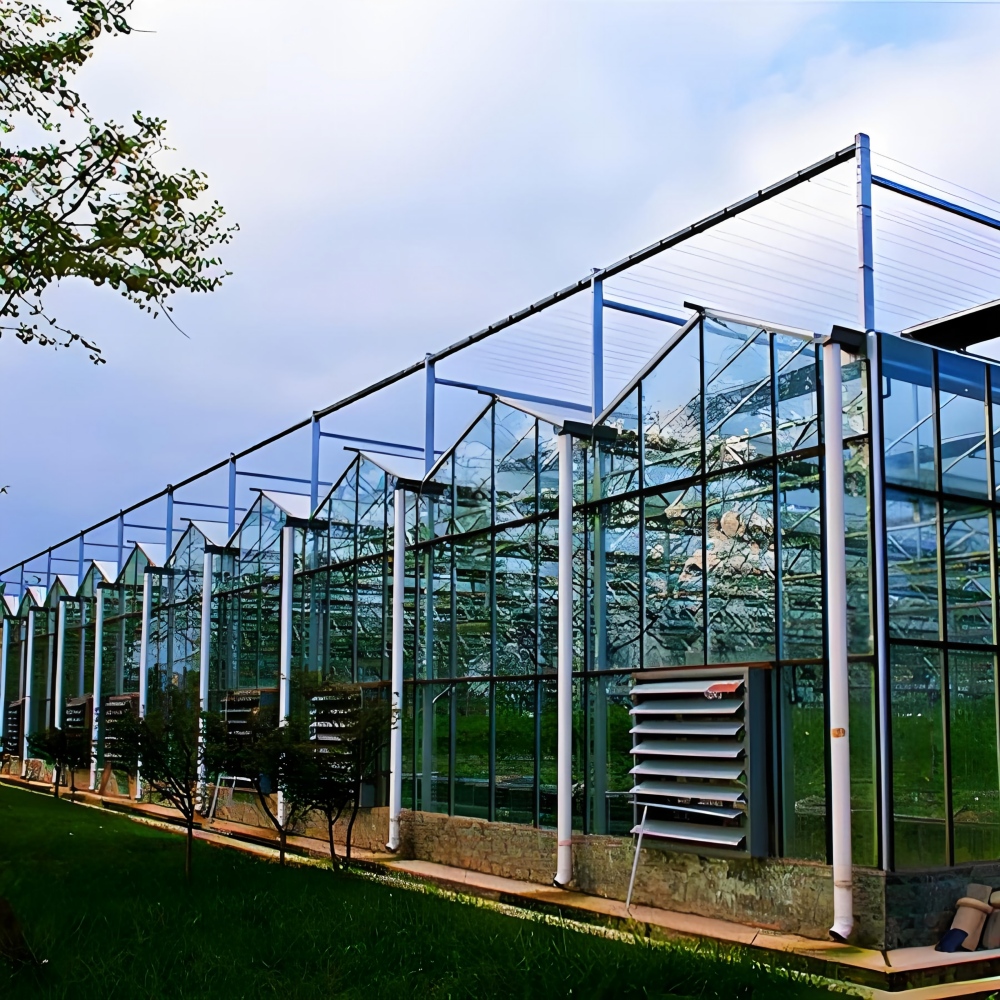
Agricultural Glass Greenhouse Investment Analysis: How to Balance Construction Costs, Energy Efficiency, and Long-Term Returns
Chapter 1: Why Should Agricultural Glass Greenhouse Projects Be Evaluated for Long-Term Investment?
Initial Construction Cost Is Only Part of the Investment
Construction cost is one of the primary concerns for investors, but it is not the only factor determining project returns. Initial investment in an agricultural glass greenhouse generally includes the main structure, glass covering system, ventilation, shading, irrigation, and intelligent control systems.Focusing solely on the lowest construction price may result in insufficient structural performance or inadequate climate control, leading to higher maintenance and upgrade costs later. A more practical investment strategy is to select suitable structures and systems based on crop requirements and operational objectives within the project budget.
Energy Efficiency Directly Affects Long-Term Operating Costs
For glass greenhouses, energy consumption is an important part of long-term operating costs. In particularly cold or hot regions, heating, cooling, and ventilation systems may need to operate frequently, making energy efficiency a direct factor in operational expenditure.
During the initial design stage, investors should plan insulation, ventilation, shading, and climate control systems according to local climate conditions. Improving natural light utilization, optimizing ventilation, and reducing unnecessary energy consumption can help control operating costs while maintaining suitable growing conditions.
Production Efficiency Determines Overall Investment Returns
The long-term value of an agricultural glass greenhouse should also be measured through production efficiency. Stable temperature, humidity, and lighting conditions provide a more consistent growing environment and support year-round production.
For commercial agricultural projects, investors should consider long-term indicators such as yield per unit area, crop quality, annual greenhouse utilization, and labor requirements rather than focusing only on the initial greenhouse price. Proper integration of automation and climate control systems can reduce labor requirements, improve production efficiency, and enhance overall investment returns.
Shift from Construction Cost to Lifecycle Value
Therefore, agricultural glass greenhouse investment should be evaluated based on lifecycle value rather than construction cost alone. A lower-priced greenhouse may have higher overall investment costs if it requires more energy, frequent maintenance, or provides limited production efficiency.
In contrast, a well-designed high-quality glass greenhouse may require a higher initial investment but offer greater long-term value by reducing operating costs, improving production efficiency, and supporting future system upgrades.
For commercial investors, the key is to find the right balance between initial investment, operating costs, and long-term returns, rather than simply choosing the lowest construction quotation.

Chapter 2: How Can Construction Costs Be Controlled for Agricultural Glass Greenhouses?
Select the Right Greenhouse Structure for the Project Scale
The greenhouse structure is a major component of construction costs. Since projects differ in cultivation area, crop types, and automation requirements, no single structure is suitable for every application.
For medium- and large-scale commercial farming projects, Venlo glass greenhouses offer a modular design, efficient space utilization, and convenient integration of ventilation, shading, and intelligent control systems. The structure can also be planned and expanded according to project scale. For other agricultural projects, the structure should be selected according to actual requirements rather than adopting unnecessarily high specifications.
Select Glass and Structural Materials Based on Actual Requirements
Glass specifications and structural materials also have a direct impact on project costs. Investors should determine suitable material specifications based on local wind conditions, snow loads, temperatures, and sunlight levels.
Insufficient specifications may affect greenhouse safety and service life, while excessive specifications can increase unnecessary upfront costs. Professional structural design should therefore balance safety, durability, and budget requirements.
Configure Automation Systems According to Operational Needs
Automation systems can improve agricultural production efficiency, but not every project needs to install a complete range of smart equipment from the beginning. Investors can configure systems according to current cultivation scale and operating methods while reserving space and interfaces for future upgrades.
For example, commercial projects can select automated ventilation, shading, irrigation, fertilization, and environmental monitoring systems according to actual requirements. A well-planned combination of systems can avoid unnecessary equipment investment while reducing labor requirements.
Do Not Compare Suppliers Based on Price Alone
When selecting an agricultural glass greenhouse supplier, comparing quotations alone can overlook design expertise, manufacturing quality, and project delivery capabilities. A lower initial quotation may ultimately result in higher costs if structural modifications, equipment replacement, or construction issues arise later.
Investors should therefore evaluate suppliers based on greenhouse design experience, manufacturing capabilities, project references, material quality, and delivery support. For large commercial projects in particular, the ability to provide a tailored solution based on local conditions and customer requirements is often more valuable than a lower initial price.
Reduce Long-Term Investment Costs Through Early-Stage Design
The key to controlling agricultural glass greenhouse construction costs is not simply choosing the lowest-priced solution, but improving overall cost efficiency through early-stage planning. A suitable structure, appropriate glass specifications, essential automation systems, and an expandable design can help investors avoid repeated construction and major modifications in the future.
Zheyang Agriculture, as a professional greenhouse design and manufacturing supplier in China, provides tailored greenhouse solutions based on project scale, climate conditions, crop requirements, investment budgets, and operational objectives. By optimizing structural and system configurations from the design stage, Zheyang Agriculture helps customers control initial investment while maintaining the long-term value of the greenhouse.
Chapter 3: How Can Energy Efficiency Reduce Agricultural Glass Greenhouse Operating Costs?
Glass Light Transmission and Natural Light Utilization
The glass covering system is an important factor affecting greenhouse energy efficiency. Good light transmission allows more natural light to enter the greenhouse, providing crops with stable lighting conditions while potentially reducing the need for supplemental lighting.
For commercial agricultural projects, glass specifications should be selected based on light transmission, structural safety, and local climate conditions rather than simply choosing the lowest-cost material. Proper glass selection can improve overall energy efficiency while meeting crop requirements.
Insulation Systems Reduce Winter Energy Consumption
For projects in cold regions, heating can become one of the largest energy expenses during winter. Therefore, insulation and heating systems should be designed according to local winter temperatures and production requirements.
A well-designed greenhouse structure, effective sealing, and properly selected heating equipment can reduce heat loss and maintain more stable internal conditions. Intelligent environmental monitoring can further adjust heating according to actual temperature, helping avoid unnecessary energy consumption.
Ventilation and Shading Reduce Summer Cooling Costs
In hot climates, greenhouse cooling can also represent a significant operating expense. Proper natural ventilation can reduce the operating time of mechanical cooling equipment, while shading systems can reduce the heat load caused by solar radiation.
Therefore, ventilation and shading systems should be designed according to local climate conditions. For example, coordinated control of roof ventilation, side ventilation, and automated shading can improve air circulation and reduce energy demand during hot periods.
Smart Control Improves Energy Efficiency
Energy efficiency depends not only on equipment performance but also on how the equipment is operated. Modern agricultural glass greenhouses can integrate temperature, humidity, and light sensors to monitor internal conditions in real time and automatically adjust ventilation, shading, heating, and irrigation systems.
This approach reduces manual intervention and helps prevent equipment from operating unnecessarily. For large commercial greenhouse projects, higher levels of automation require careful system planning to ensure that different components operate efficiently together.
Improve Long-Term ROI by Optimizing Energy Costs
For agricultural glass greenhouses, the value of energy-efficient design goes beyond reducing a single operating expense. It directly affects the long-term return on investment. Proper selection of glass, insulation, ventilation, shading, and intelligent control systems can reduce energy consumption while creating a more stable growing environment.
Therefore, investors should evaluate not only the initial construction quotation but also future energy consumption and operating costs. A lower construction cost does not necessarily mean a lower total investment cost. A commercially valuable greenhouse solution should balance initial investment, energy efficiency, and long-term returns.
Chapter 4: Zheyang Agriculture Agricultural Glass Greenhouse Solutions: Optimizing Investment Returns from Design to Manufacturing
For agricultural glass greenhouse projects, investment returns depend not only on greenhouse quality but also on initial design, system configuration, and manufacturing capabilities. A well-planned greenhouse solution can meet crop production requirements while controlling construction costs and reducing long-term operating and maintenance expenses.
As a professional greenhouse design and manufacturing supplier in China, Zheyang Agriculture provides tailored agricultural glass greenhouse solutions for different commercial projects, offering project support from initial requirements analysis and solution design to manufacturing.
Optimize Greenhouse Design According to Project Requirements
Different agricultural projects have different greenhouse requirements. Greenhouse size, crop type, local climate, production model, and automation level all influence the final design.
During the initial project stage, Zheyang Agriculture analyzes customer requirements and considers the greenhouse structure, glass covering system, ventilation, shading, irrigation, and climate control systems. For large commercial farming projects, modular greenhouse structures can be planned according to production scale, with space reserved for future expansion and system upgrades.
This project-based design approach helps avoid unnecessary equipment and material investment while improving the compatibility between the greenhouse system and actual production needs.
High-End Glass Greenhouses Combine Production Efficiency with Long-Term Value
Agricultural glass greenhouses should not only provide basic cultivation functions but also create stable growing conditions for long-term production. High-quality glass covering can provide consistent natural lighting, while properly designed ventilation, shading, and climate control systems help maintain suitable growing conditions.
For commercial agricultural projects, these systems provide value beyond the construction stage and continue to influence operational efficiency, energy consumption, and production stability.
Therefore, investors should evaluate the overall lifecycle value of a greenhouse rather than focusing only on the initial quotation.
Ensure Project Quality Through Reliable Manufacturing
Once the greenhouse design is finalized, manufacturing quality also has a direct impact on project performance. Structural dimensions, material quality, corrosion protection, and glass installation compatibility all affect greenhouse stability and service life.
Zheyang Agriculture integrates design with manufacturing and produces greenhouse structures and components according to project requirements. Appropriate material selection and manufacturing processes can reduce dimensional deviations and on-site adjustments, improving project implementation efficiency.
For large commercial projects, reliable manufacturing capabilities help customers better control project schedules and quality while reducing potential maintenance risks.
Zheyang Agriculture Provides Tailored Agricultural Glass Greenhouse Solutions
Zheyang Agriculture does not rely on a single standardized greenhouse solution. Instead, solutions are tailored according to the customer's climate conditions, crop requirements, investment budget, and production goals.
Services include:
- Project requirements analysis;
- Greenhouse structural design;
- Glass and material selection;
- Ventilation, shading, and climate control planning;
- Greenhouse manufacturing;
- Project delivery support.
This integrated approach from design to manufacturing helps reduce communication costs between different supply stages and ensures better coordination between the greenhouse structure, covering system, and supporting equipment.
Optimize Investment Returns Through a Lifecycle Approach
The investment value of an agricultural glass greenhouse should be evaluated throughout its lifecycle, from construction and operation to long-term maintenance. Proper initial design can control upfront investment, efficient energy systems can reduce operating costs, and reliable structural and manufacturing quality can help minimize long-term maintenance requirements.
Through tailored design and manufacturing services, Zheyang Agriculture helps customers configure greenhouse systems according to actual project requirements while balancing construction costs, energy efficiency, production capacity, and future expansion.
For investors developing long-term commercial agricultural projects, choosing the right greenhouse supplier is not simply about purchasing a greenhouse. It is about establishing a solid foundation for future production efficiency and investment returns.
Chapter 5: How Should the Long-Term ROI of an Agricultural Glass Greenhouse Be Evaluated?
An agricultural glass greenhouse is a long-term investment, so its return should not be evaluated simply by comparing construction costs with sales revenue. For commercial agricultural projects, investors need to assess the production value generated throughout the greenhouse's operating lifecycle, together with energy, labor, and maintenance costs.
Before construction, investors should therefore evaluate production capacity, operating costs, greenhouse utilization, and future expansion potential to determine the project's long-term investment value.
Evaluate Production Capacity per Unit Area
Production capacity per unit area is an important indicator of greenhouse investment value. A larger greenhouse does not necessarily generate higher returns. The key is to improve effective output per unit area through appropriate structural design and environmental control.Investors can evaluate potential production returns based on crop types, cultivation cycles, expected yields, and market prices. Greenhouse utilization should also be considered. If environmental control allows more stable year-round production, the overall utilization of the facility can be improved.
Calculate Long-Term Energy and Maintenance Costs
Long-term returns depend not only on production but also on operating expenses. Heating, cooling, ventilation, irrigation, and climate control systems can all generate ongoing costs.These expenses should therefore be included when evaluating investment returns rather than focusing only on the initial quotation. A greenhouse with a lower construction cost may still have higher total operating costs if it consumes more energy or requires frequent maintenance.
Proper design and equipment configuration can reduce unnecessary energy consumption while meeting crop requirements and minimizing maintenance needs, ultimately improving overall project returns.
Consider Year-Round Production Capacity
For commercial agricultural projects, improving annual greenhouse utilization is an important way to increase investment returns. Traditional outdoor farming is highly affected by seasons and weather, while agricultural glass greenhouses can provide a more stable growing environment through ventilation, shading, heating, and climate control systems.A stable production environment can improve crop quality while allowing businesses to manage cultivation cycles and production schedules more effectively. For high-value crops, consistent supply can also become an important competitive advantage.
Consider Future Upgrades and Expansion
Agricultural projects usually have long development cycles, making the greenhouse's upgrade and expansion capabilities important factors in long-term investment value.During the initial design stage, investors should consider whether they may need to expand cultivation areas, add automation equipment, or upgrade climate control systems in the future. A compatible and expandable greenhouse system allows businesses to upgrade gradually as operations grow, instead of rebuilding the entire facility.For large commercial projects, this flexibility can reduce future expansion costs and allow the greenhouse infrastructure to adapt to changes in production scale and agricultural technology.
Evaluate ROI Across the Entire Lifecycle
Evaluating the ROI of an agricultural glass greenhouse ultimately requires a lifecycle approach. Investors should consider initial construction investment, energy and maintenance costs, production capacity per unit area, and annual greenhouse utilization together rather than focusing on a single cost factor.
A commercially valuable agricultural glass greenhouse should achieve a practical balance between construction costs, operational efficiency, and production returns. Since every project is different, the optimal solution should be designed according to local climate, crop types, budget, and production objectives.
Through tailored greenhouse design and manufacturing services, Zheyang Agriculture optimizes greenhouse structures and supporting systems according to specific project requirements, helping investors balance initial investment with energy efficiency, production capacity, and future expansion while building a stronger foundation for long-term commercial agricultural returns.
Chapter 6: How Can Investors Balance Construction Costs, Energy Efficiency, and Returns?
Step 1: Control Initial Construction Costs
The key to controlling construction costs is not choosing the lowest quotation, but selecting appropriate structures and equipment based on actual production requirements. Greenhouse size, structural type, glass specifications, ventilation, shading, and automation level all affect the total investment.
During project planning, investors should first define crop types, cultivation scale, and operational objectives before determining system configurations. For example, large commercial agricultural projects can use modular glass greenhouse structures based on production scale and install automation systems according to actual needs. For equipment that is not immediately necessary, upgrade interfaces can be reserved to avoid excessive upfront investment.
Step 2: Reduce Operating Costs Through Energy-Efficient Design
After construction, energy costs continue to affect greenhouse profitability. Therefore, considering energy efficiency during the initial design stage is generally more effective than carrying out energy-saving modifications later.Glass light transmission, greenhouse sealing, ventilation, shading, heating, and cooling systems all affect energy consumption. Investors should configure these systems according to local climate conditions to maintain stable crop growth while reducing unnecessary energy use.
For example, cold regions should focus on insulation and heating efficiency, while hot regions require effective natural ventilation, mechanical ventilation, and shading. Project-specific configuration avoids applying the same greenhouse solution to different climates.
Step 3: Improve Returns per Unit Area
Reducing costs is only one part of investment management. Improving production returns is equally important. For commercial agricultural projects, the value of a greenhouse should ultimately be reflected in yield per unit area, crop quality, and year-round production capacity.Proper climate control systems can maintain suitable temperature, humidity, and lighting conditions, creating a more stable growing environment. Automated irrigation, fertilization, and environmental monitoring can also reduce manual work and improve production efficiency.
Therefore, investors should focus on how much value can be generated per square meter, rather than simply comparing construction costs per square meter. For high-value crops, improving production stability and quality may provide greater commercial value than simply reducing initial investment.
Choose a Greenhouse Supplier with Long-Term Planning Capabilities
The balance between construction costs, energy efficiency, and investment returns depends largely on the greenhouse solution itself. A professional supplier should provide more than a greenhouse product; it should develop an overall solution based on project location, crop requirements, and operational objectives.As a professional greenhouse design and manufacturing supplier in China, Zheyang Agriculture provides tailored greenhouse solutions for commercial agricultural projects. Greenhouse structures and supporting systems are planned according to the customer's climate conditions, crop types, project scale, investment budget, and production goals.
From design and material selection to manufacturing, Zheyang Agriculture focuses on system compatibility, helping customers avoid unnecessary configurations while considering service life, energy efficiency, and future upgrade potential.
Adopt a Lifecycle Investment Approach
Investors can evaluate a project through three key steps:
Control initial investment → Optimize energy efficiency → Improve production returns
By controlling construction costs while meeting safety and production requirements, reducing long-term energy consumption through project-specific design, and improving productivity with automation and climate control, investors can create a more sustainable investment structure.


