



2026-11-17
How do the structures of high-wire commercial tomato greenhouses withstand typhoons?
In the high-wire cultivation of indeterminate tomatoes, growers typically require a gutter height of 5.0 to 6.5 meters. This not only creates a larger internal air buffer—which helps mitigate sharp fluctuations in ambient temperature—but also provides overhead space for automated shading systems and horizontal circulation fans, while accommodating long, trailing vines to prevent overcrowding within the plant canopy. Evidently, greenhouses designed for high-wire tomato cultivation have significant vertical space requirements.
If a greenhouse were constructed using only standard, lightweight agricultural arches, the combined forces of horizontal wind shear, vertical aerodynamic uplift, and the weight of the crops would trigger a catastrophic torsional failure, leading to a progressive, chain-reaction collapse of the entire framework. To ensure stability during high winds, high-wire commercial tomato greenhouses cannot be viewed merely as simple agricultural facilities; rather, they must be designed and constructed as industrial-grade, controlled-environment structures that strictly adhere to light-gauge steel engineering standards.
How can the destruction of commercial multi-span greenhouses by strong winds be prevented?
- Triangular Rigid Shear-Bracing System: Along the windward perimeter and the end gables of the greenhouse, "X-shaped" (or "inverted V-shaped") shear braces—constructed from thick-walled, rigid steel tubing—are installed at fixed modular intervals. Leveraging the inherent geometric stability of triangles, these braces convert any horizontal thrust into axial tension or compression within the diagonal members, effectively locking the frame against lateral displacement.
- High-Strength Prestressed Wind-Resistant Tension Cables: A dense network of tension cables, equipped with high-strength turnbuckles, is installed between the longitudinal gutter lines and the internal vertical columns. During installation, the cables are prestressed to eliminate any mechanical slack. When subjected to high winds, the cables on the windward side instantly become taut, providing tensile resistance; this creates a synergistic structural response that combines flexibility with rigidity, allowing individual points of resistance to support the entire assembly.
Why do multi-span tomato greenhouse supplier strongly recommend high-wire plastic film greenhouses?
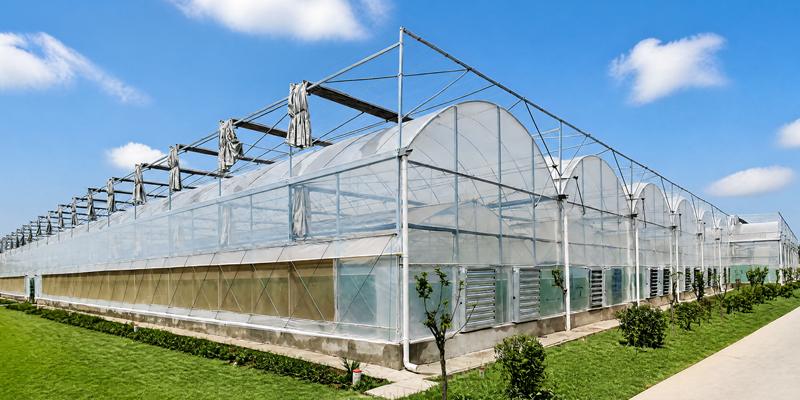
Once the challenge of structural wind resistance has been addressed, overseas buyers face another critical decision: when cultivating tomatoes, should they opt for traditional glass greenhouses or film-covered greenhouses? And what specific requirements should these greenhouses meet? As a professional multi-span tomato greenhouse supplier, Zheyang recommends high-clearance, film-covered greenhouses—engineered for heavy-duty wind resistance—to large-scale tomato producers aiming for high yields and a high percentage of marketable fruit. Below, we present a practical, ready-to-implement solution.
- Return on Investment (ROI): For a given area—equipped with modern integrated irrigation and fertilization systems as well as internal shading—an elevated-trough film greenhouse costs only half as much as a glass greenhouse. This allows growers to reallocate their budget toward high-quality seedlings and automated environmental control systems. Since the yield of elevated-trough tomatoes depends on factors such as variety, light exposure, nutrient/water formulation, and microclimate management—all of which can be effectively supported by film-covered structures—growers can typically recover their initial investment within 2–3 years, while simultaneously reducing operational risks.
- A Natural Barrier for Microclimate Regulation: Direct sunlight can be overly intense, potentially scorching the tender apical shoots of tomato plants or causing localized overheating of fruit during midday, which leads to "sunscald" or uneven ripening. Modern commercial multi-span greenhouses utilize 5-layer co-extruded, light-diffusing PO (polyolefin) film. This material converts direct sunlight into soft, omnidirectional diffused light. Furthermore, the film’s surface is treated with a permanent hydrophilic anti-drip agent; condensation that forms during the night or early morning spreads into a thin, uniform water film, which then drains into the side gutters, preventing water droplets from falling onto the crops.
- Resilience Against Extreme Weather: High-polymer, resilient PO film offers excellent elasticity, impact resistance, and puncture resistance, often remaining intact even during severe hailstorms. High-quality, UV-stabilized film typically has a service life of 3–5 years. When replacement is necessary, the greenhouse’s pre-installed high-strength aluminum alloy profiles and spring-locking clips allow for rapid re-covering of the entire structure, ensuring that agricultural production is not subjected to prolonged downtime.
Why are high-wire commercial tomato greenhouses so strongly recommended? High-yielding tomato plants can reach a total growth length of 10–15 meters over a continuous 10–11 month harvest period. A gutter height of 5.0 to 6.5 meters is essential to provide sufficient vertical space for the "lowering" (or "layering") of vines—accommodating the distance between the overhead support wires and the suspended coir grow-slabs—thereby ensuring that vine-lowering is smooth and labor-efficient for workers. Hot air naturally rises and accumulates above the plant canopy, from where it is rapidly vented through continuous roof openings; meanwhile, the root zones and fruit at the lower levels remain in a comfortable microclimate with gentle air circulation. Furthermore, the steel pipes installed on the ground—which serve both as heating elements and as tracks for mechanized harvest carts—enable efficient winter heating and streamlined, automated harvesting, boosting land-use efficiency to over 90%.