







How Can Integrated Agricultural Greenhouse Solutions Drive Modern Agriculture Upgrades? A Complete Guide from Project Planning to Smart Operations
Chapter 1: Why Does Modern Agriculture Need Integrated Greenhouse Solutions?
As commercial agriculture becomes more large-scale, professional, and technology-driven, a greenhouse is no longer simply a protected growing space. For modern agricultural projects, the greenhouse structure, covering materials, ventilation, cooling, heating, shading, irrigation, fertigation, and smart control systems need to work together to support efficient long-term production.
Traditional procurement often involves purchasing the greenhouse structure and supporting equipment separately. This can lead to compatibility issues, higher modification costs, and limited operational efficiency. An integrated approach considers climate, crop type, project scale, budget, and production goals from the planning stage, allowing the greenhouse structure and supporting systems to be designed as a coordinated solution.
Therefore, modern agriculture needs more than a single “greenhouse product.” It needs a systematic solution built around actual production requirements. From initial planning and structural design to climate control and smart operations, an integrated greenhouse solution can improve resource utilization while providing greater flexibility for future expansion and technology upgrades.
Chapter 2: How Should an Agricultural Greenhouse Project Be Planned from the Start?
A successful agricultural greenhouse project should begin with overall planning rather than simply selecting a greenhouse type or equipment. Local climate conditions provide the foundation for greenhouse design. Temperature, rainfall, wind, snow loads, and solar radiation should all be considered when determining the greenhouse structure, covering materials, ventilation, cooling, and insulation systems.
The next step is to define the crops and production methods. Tomatoes, cucumbers, strawberries, leafy vegetables, and other crops have different requirements for temperature, humidity, light, and water and nutrients. Soil cultivation, substrate growing, and hydroponics also affect greenhouse layout and system selection. Therefore, the greenhouse should be designed around the actual growing requirements.
Project scale, budget, and production goals should also be defined at an early stage. Smaller commercial projects may prioritize investment costs and essential functions, while large agricultural projects often focus more on production efficiency, automation, and future scalability. Evaluating these factors during the planning stage helps reduce later modifications and provides a clearer foundation for greenhouse construction and operation.
Chapter 3: What Are the Core Systems of an Integrated Agricultural Greenhouse Solution?
An integrated agricultural greenhouse solution typically consists of the main greenhouse structure, climate control, irrigation and fertigation, and smart control systems. These systems should not operate independently. Instead, they need to be coordinated according to the local climate, crop type, and production goals to create a stable and efficient growing environment.
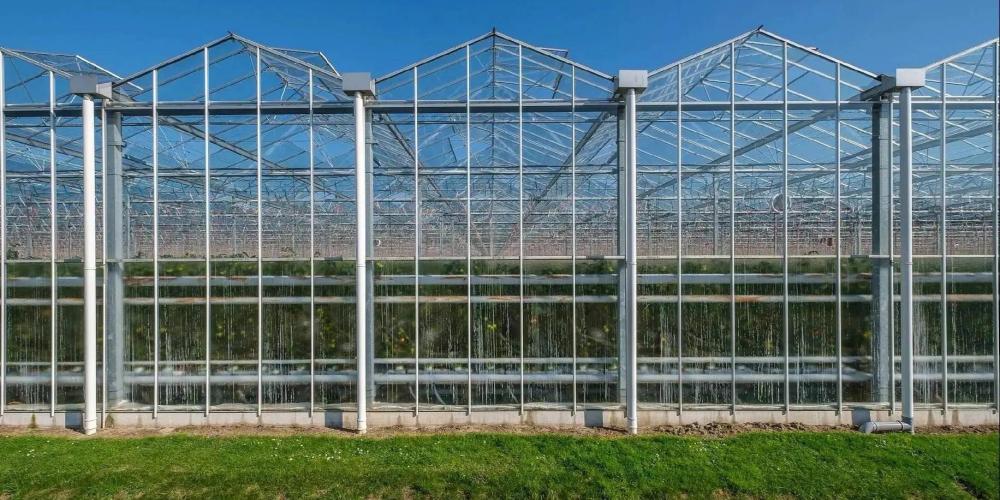
The first component is the greenhouse structure and covering system, including Venlo, multi-span, glass, polycarbonate, film, and tunnel greenhouses. Different structures and covering materials vary in light transmission, insulation, weather resistance, space utilization, and construction cost, so the selection should be based on project requirements.
The second component is the climate control system, including ventilation, cooling, heating, shading, insulation, and supplemental lighting. These systems help regulate temperature, humidity, and light. Irrigation and fertigation systems provide precise water and nutrient management through solutions such as drip irrigation and integrated fertigation.
On this basis, a smart control system can connect environmental sensors with different greenhouse devices, monitor parameters such as temperature, humidity, and light, and automatically adjust equipment according to preset conditions. By integrating these systems, a greenhouse can evolve from a simple growing facility into a more systematic and automated modern agricultural production environment.
Chapter 4: How Should Different Agricultural Projects Choose the Right Greenhouse Solution?
Different agricultural projects have different greenhouse requirements. Therefore, selecting an integrated solution should not be based solely on greenhouse prices or structural types. Location, crop type, project scale, budget, and production goals should all be considered. The right solution should ensure that the greenhouse structure and supporting systems work together effectively for long-term operation.
For large-scale commercial farms and agricultural parks, multi-span or Venlo greenhouses can be suitable for intensive production. These projects can be equipped with ventilation, cooling, shading, heating, irrigation, and smart control systems according to crop requirements. For small and medium-sized commercial projects with tighter budgets, film or tunnel greenhouses can provide practical and cost-conscious options.
High-value crop projects often require more precise control of temperature, humidity, light, and water and nutrients. Glass or polycarbonate greenhouses combined with automated climate and fertigation systems may therefore be considered. In regions with high temperatures, cold climates, or strong wind and snow conditions, structural strength, covering performance, insulation, ventilation, and cooling capacity should receive greater attention.
Therefore, selecting an integrated greenhouse solution is essentially a process of matching different components to project requirements. By determining the greenhouse structure, covering materials, supporting equipment, and automation level according to actual needs, buyers can avoid over-specification or insufficient functionality while leaving room for future expansion and smart upgrades.
Chapter 5: What Integrated Agricultural Greenhouse Solutions Does Zheyang Agriculture Provide?
As a professional greenhouse design and manufacturing supplier in China, Zheyang Agriculture does more than provide standardized greenhouse products. We develop and manufacture solutions according to specific project requirements. By considering project location, climate conditions, crop type, scale, budget, and production goals, we provide tailored integrated greenhouse solutions for commercial agricultural projects.
For greenhouse structures, Zheyang Agriculture offers various solutions, including Venlo, multi-span, glass, polycarbonate, film, tunnel, and Gothic greenhouses. Depending on project requirements, different covering materials such as glass, polycarbonate panels, and PE/PO film can be selected to balance light transmission, insulation, weather resistance, and investment costs.


