



2026-11-16
Double glazed greenhouses used in modern horticulture address both thermal insulation and photosynthesis requirements
In high-latitude regions—such as North America, Northern Europe, and Central Asia—winter presents a significant challenge for commercial greenhouse operators: how to strike the right balance between light and heat. For years, growers have been reluctant to adopt thick, insulated glass units, fearing that an additional layer of glass would restrict the amount of sunlight reaching their crops. While standard commercial glass offers a hemispherical light transmission of 89%–91%, traditional double glazing reduces this figure to 78%–82%. In regions with low solar radiation during the winter, this reduction directly hinders the growth of crops like tomatoes, bell peppers, and strawberries, leading to stunted vegetative development, poor flowering, and low fruit weight. Through continuous research and development, Zheyang has addressed this issue by creating a double glazed greenhouse system that utilizes prismatic diffused tempered glass for the outer layer and clear float glass for the inner layer—a solution that perfectly balances light and thermal requirements.
A meticulously designed "dual light effect" architecture:
- Outer glass: 4mm-thick diffuse tempered glass, featuring a micro-textured prismatic surface—achieved through precise chemical etching or prismatic embossing—that converts direct light beams into multi-angle diffuse light.
- Sealed air space: A carefully engineered thermal barrier, the cavity is filled with dry air or an inert gas, separated by a 9 mm/12 mm spacer. This configuration achieves a U-value of approximately 2.6–3.0 W/m²·K and reduces conductive heat loss by 40%–50% compared to single-pane glass.
- Inner layer of glass: 4mm float glass, manufactured using a low-iron process, ensures exceptional optical clarity. This allows diffused light to enter the cultivation space directly, preventing unnecessary losses caused by secondary scattering.
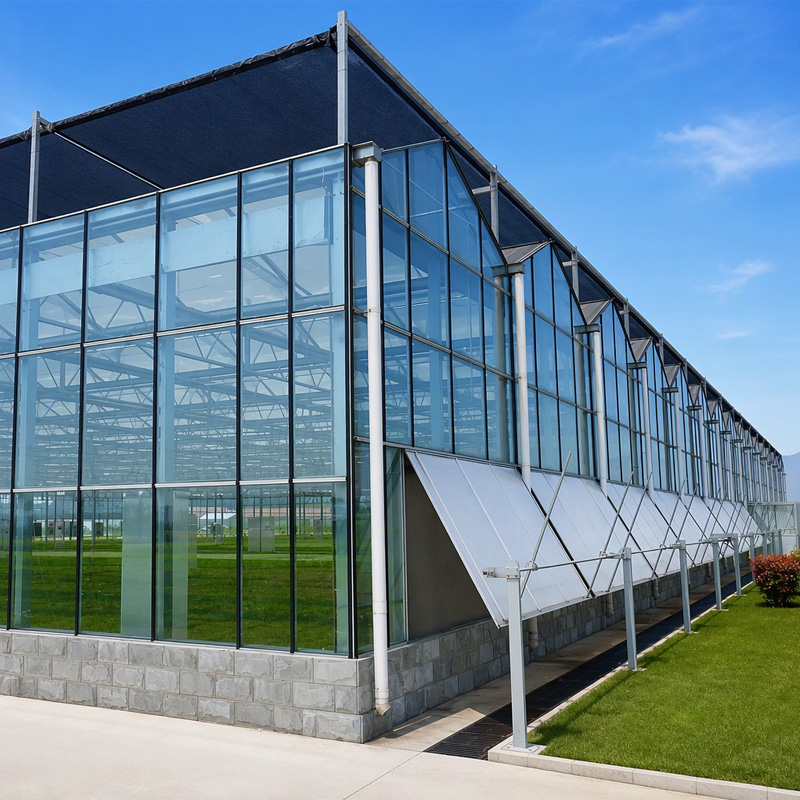
Why is the effect of diffused light in double glazed greenhouses considered superior to that of direct light?
- Eliminating structural shadows and light spots: Direct sunlight casts heavy shadows beneath steel trusses and drainage gutters; in contrast, diffused light bypasses these obstacles, eliminating shadows and ensuring uniform ambient illumination across crop rows.
- Reaching leaves in the middle and lower canopy: Under direct sunlight, upper leaves often reach a state of light saturation—rendering excess photons wasted—while lower leaves receive negligible photosynthetically active radiation. Diffused light, however, scatters both horizontally and obliquely, activating leaves throughout all layers of the canopy for photosynthesis.
- Lowering leaf temperature: Direct light creates concentrated infrared "hot spots" on upper leaves. Diffused-light glass ensures that radiation is distributed evenly across the entire leaf surface; in clear yet cold weather, this can lower the peak temperature of the canopy by several degrees, effectively preventing leaf-tip burn.
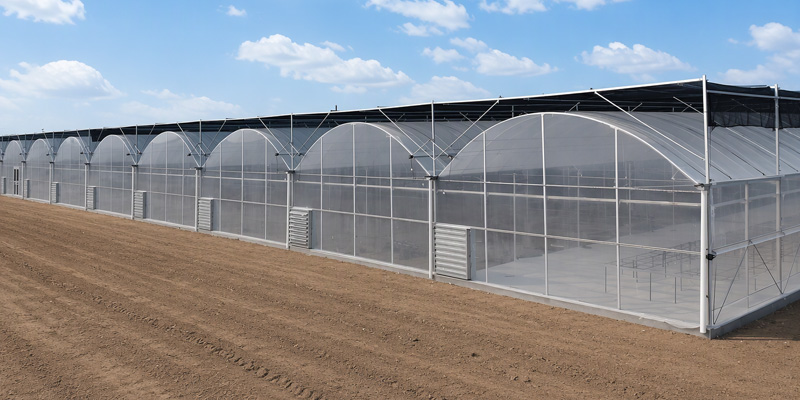
In modern facility agriculture, indeterminate, vine-trained tomatoes represent a high-value, technology-intensive crop in global commercial greenhouses—and one that is exceptionally demanding regarding microclimate control. With a production cycle typically spanning 10 to 11 months, these crops require continuous fruit setting and harvesting, even through the depths of winter. Consequently, growers have stringent requirements for their commercial tomato greenhouses. As a Venlo glass greenhouse manufacturer, Zheyang offers a configuration featuring an outer layer of diffuse-scattering glass and an inner layer of high-transparency insulated (double-glazed) glass, providing significant economic advantages: